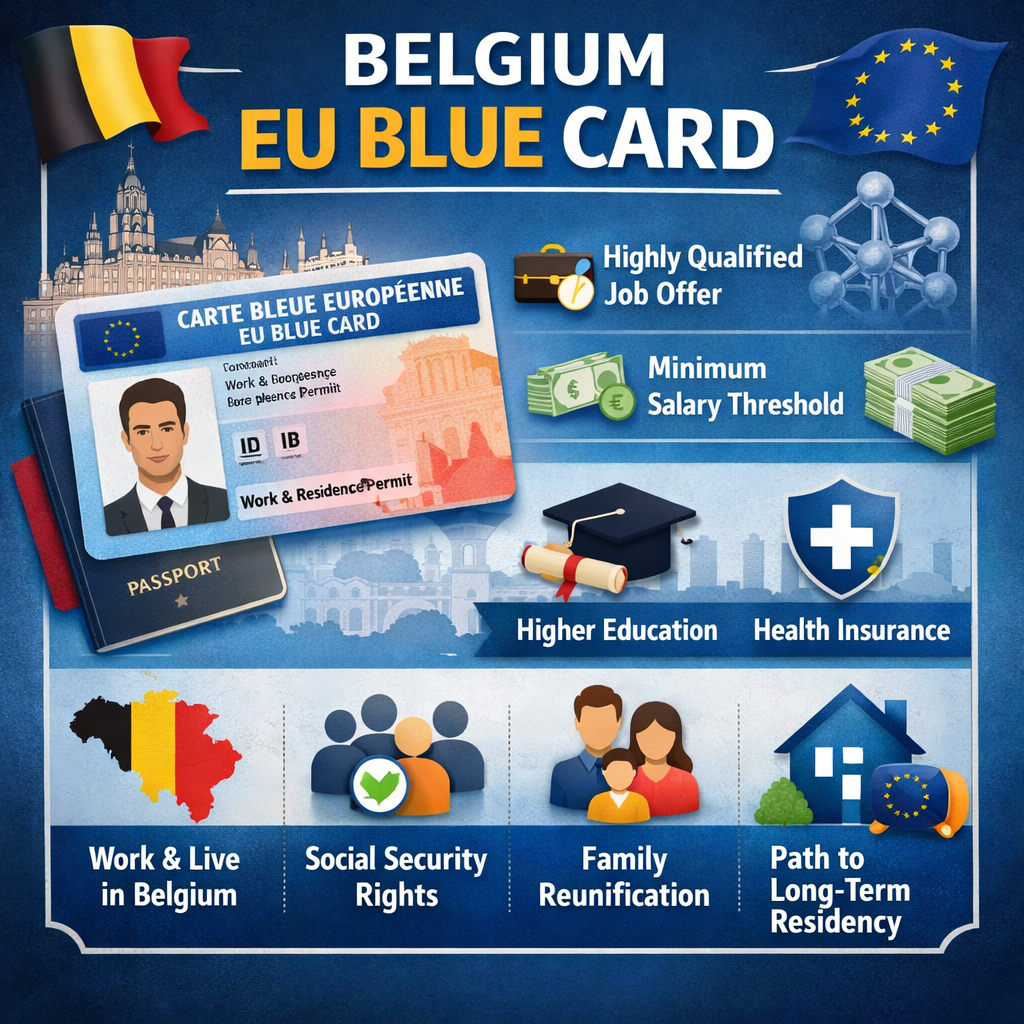

Are you a skilled professional looking to work in Belgium? The EU Blue Card might be your golden ticket. This special work permit is designed for highly qualified workers from outside the European Union. It offers many benefits and can be your pathway to living and working in one of Europe’s most dynamic countries.
Belgium is home to major international organizations, thriving tech companies, and world-class research institutions. The country needs talented professionals in fields like IT, engineering, healthcare, and finance. The Blue Card makes it easier for qualified workers to fill these positions while enjoying excellent benefits and career opportunities.
This guide explains everything you need to know about the Blue Card in Belgium, from eligibility requirements to the application process and beyond.
Key Takeaways
- The EU Blue Card is a work and residence permit for highly skilled non-EU workers
- You need a job offer with a minimum salary of around 56,000 euros per year in Belgium
- A university degree or at least 5 years of professional experience is required
- The application process takes 4 to 6 months on average
- Blue Card holders can bring family members to Belgium
- After 5 years, you may be eligible for long-term residence in the EU
- The card is valid for up to 4 years and can be renewed
- Belgium’s Blue Card offers easier mobility within the EU compared to regular work permits
What is the EU Blue Card?
The EU Blue Card is a work and residence permit that allows highly qualified professionals from outside the European Union to work in EU member states. Think of it as Europe’s answer to the US Green Card, but specifically for skilled workers.
Why Belgium Offers the Blue Card
Belgium actively seeks talented professionals to support its economy. The country has shortages in several sectors, including:
- Information technology and software development
- Engineering and technical fields
- Healthcare and medical research
- Financial services and consulting
- Scientific research and academia
The Blue Card program helps Belgium attract these professionals while offering them a clear path to long-term residence and excellent working conditions.

Benefits of the Blue Card in Belgium
Professional advantages:
- Work legally in a highly skilled position
- Access to Belgium’s strong job market
- Competitive salaries and benefits
- Professional development opportunities
- Recognition of your qualifications
Personal benefits:
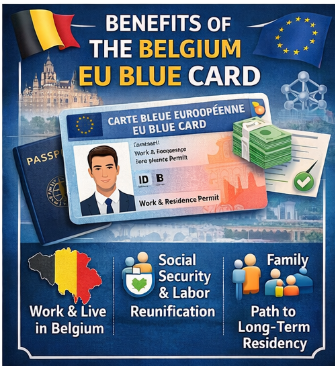
- Live in Belgium with your family
- Access to quality healthcare
- Children can attend Belgian schools
- Travel freely within the Schengen area
- Path to permanent residence after 5 years
EU mobility: After 18 months in Belgium, you can move to another EU country for work more easily than with a regular work permit.
Belgium Blue Card Eligibility Requirements
Not everyone qualifies for the Blue Card. Belgium has specific criteria you must meet. Let’s break down each requirement in detail.
Educational Qualifications
You must have one of the following:
Option 1: Higher education degree
- Bachelor’s degree (minimum 3 years of study)
- Master’s degree
- PhD or doctorate
Important details:
- The degree must be recognized in Belgium or your home country
- It should be relevant to the job you’re applying for
- You’ll need official transcripts and diploma copies
Option 2: Professional experience If you don’t have a degree, you can qualify with:
- At least 5 years of professional experience
- Experience must be in the same field as your job offer
- Must be at a comparable level to a university degree
Proof needed:
- Employment letters from previous employers
- Job descriptions showing your responsibilities
- Reference letters confirming your experience
- Portfolio of work (if applicable)
Job Offer Requirements
You must have a binding job offer from a Belgian employer. The job must meet these criteria:
Salary threshold: Your gross annual salary must be at least 1.5 times the average gross annual salary in Belgium. For 2024-2025, this is approximately:
- Minimum: 56,000 euros per year
- This equals about 4,670 euros per month (gross)
Note: This threshold is updated annually based on Belgium’s average salary statistics.
Contract type:
- Employment contract for at least 12 months
- Can be a permanent contract or fixed-term contract
- Must specify salary, job title, and responsibilities
- Should be signed by both you and the employer
Job level: The position must require high qualifications. Typical Blue Card jobs include:
- Software engineers and IT specialists
- Medical doctors and healthcare professionals
- Scientists and researchers
- Engineers (civil, mechanical, electrical, etc.)
- Financial analysts and consultants
- University professors and lecturers
- Architects and urban planners
Employer Requirements
Your Belgian employer must meet certain conditions:
Legal status:
- Registered and operating legally in Belgium
- In good standing with tax and social security authorities
- No serious violations of labor laws
Authorization: Some employers need specific authorization to hire foreign workers. Your employer should verify this with Belgian immigration authorities.
Valid Passport
You must have:
- A passport valid for at least 12 months beyond your planned arrival
- At least two blank pages for visa stamps
- Passport issued within the last 10 years
Health Insurance
You need proof of health insurance that covers:
- Medical treatment in Belgium
- Emergency care
- Hospitalization
- Repatriation if necessary
Options:
- Private international health insurance (before arrival)
- Belgian social security (once employed)
- Your employer should register you for Belgian healthcare
Clean Criminal Record
You must provide:
- Criminal record certificate from your home country
- Additional certificates from any country where you lived for more than 6 months in the past 5 years
- Documents must be recent (issued within 6 months)
- Translated into French, Dutch, or German (Belgium’s official languages)
- Apostilled or legalized
Sufficient Accommodation
You need proof of where you’ll live in Belgium:
- Rental contract
- Property ownership documents
- Letter of invitation if staying with someone
- Hotel reservation for initial period (if searching for permanent housing)
Blue Card Belgium Eligibility Checklist
| Requirement | Details | Documents Needed |
|---|---|---|
| Education | University degree or 5+ years experience | Diploma, transcripts, or employment letters |
| Job Offer | Minimum 56,000 euros/year, 12-month contract | Signed employment contract |
| Passport | Valid 12+ months | Passport copy |
| Health Insurance | Comprehensive coverage | Insurance policy or employer confirmation |
| Criminal Record | Clean background | Certificate from home country |
| Accommodation | Proof of housing in Belgium | Rental contract or invitation letter |
| Language | Not mandatory but helpful | None required for application |
How to Apply for a Blue Card in Belgium
The application process involves several steps and requires careful preparation. Here’s exactly what you need to do.
Step 1: Secure a Job Offer
Before applying for the Blue Card, you need a firm job offer from a Belgian employer.
How to find jobs:
- Use international job boards (LinkedIn, Indeed, Glassdoor)
- Check Belgian job sites (StepStone.be, JobsInBrussels.com)
- Apply directly to company websites
- Attend international job fairs
- Work with recruitment agencies specializing in Belgium
During the interview process:
- Mention you’ll need Blue Card sponsorship
- Confirm the salary meets the threshold
- Discuss relocation support
- Clarify start date expectations
Step 2: Employer Obtains Work Authorization
Your employer must request authorization from Belgian authorities to hire you. This involves:
What your employer does:
- Submits request to the regional employment office
- Provides job description and justification
- Demonstrates they couldn’t find a qualified EU candidate
- Pays any required fees
Processing time: 2 to 4 weeks
Your role: Provide your employer with all necessary personal documents.
Step 3: Gather Your Documents
While your employer handles authorization, start collecting your documents:
Required documents:
- Completed Blue Card application form
- Valid passport (original and copies)
- Recent passport photos (2-3 photos, meeting biometric standards)
- University degree or proof of professional experience
- Employment contract signed by both parties
- Proof of salary meeting the threshold
- Criminal record certificate (apostilled and translated)
- Health insurance certificate
- Proof of accommodation in Belgium
- CV (detailed resume)
- Work authorization from regional employment office
Additional documents (if applicable):
- Marriage certificate (if bringing spouse)
- Birth certificates (if bringing children)
- Previous work permits or visas
- Academic transcripts
- Professional licenses or certifications
Important tips:
- Get documents translated by certified translators
- Apostille documents from non-EU countries
- Make multiple copies of everything
- Keep originals in a safe place
Step 4: Submit Your Application
You apply at the Belgian embassy or consulate in your home country or country of legal residence.
Application process:
- Schedule an appointment online or by phone
- Arrive on time with all documents organized
- Submit application form and supporting documents
- Pay the application fee (approximately 200-300 euros)
- Provide biometric data (fingerprints and photo)
- Attend interview if required
Interview questions might include:
- Why do you want to work in Belgium?
- Tell us about your qualifications and experience
- What are your career goals?
- Do you speak any Belgian languages?
- Have you visited Belgium before?
Step 5: Wait for Processing
After submitting your application, authorities will review everything.
Processing timeline:
- Average: 4 to 6 months
- Can be faster: 2 to 3 months with complete documentation
- May take longer: 6 to 9 months if additional verification needed
What happens during processing:
- Document verification
- Background checks
- Medical checks (sometimes required)
- Employer verification
- Security clearances
Checking status:
- You’ll receive a reference number
- Contact the embassy for updates
- Some offices offer online tracking
Step 6: Receive Your Decision
You’ll be notified of the decision by email or phone.
If approved:
- Collect your visa from the embassy
- You’ll receive a Type D visa (long-stay visa)
- Must travel to Belgium within the visa validity period (usually 6 months)
If rejected:
- You’ll receive written reasons for rejection
- You can appeal the decision within 30 days
- Or correct issues and reapply
Step 7: Travel to Belgium
Once you have your visa, you can travel to Belgium.
Upon arrival:
- Enter through any Schengen country
- Proceed to Belgium within the visa validity period
- Must register with local commune (municipal office) within 8 days
Step 8: Register in Belgium
Within 8 working days of arrival, you must register with your local commune.
What to bring:
- Passport with visa
- Proof of accommodation
- Employment contract
- Health insurance
- Passport photos
What happens:
- You’ll be issued a registration certificate
- Biometric data collected again
- Receive your EU Blue Card (plastic card)
- Get your residence permit
Timeline: Your physical Blue Card arrives within 4 to 6 weeks.
Application Timeline Overview
| Stage | Duration | Action Required |
|---|---|---|
| Job Search | 1-6 months | Apply for jobs meeting Blue Card criteria |
| Job Offer | Immediate | Negotiate and sign contract |
| Work Authorization | 2-4 weeks | Employer submits request |
| Document Preparation | 2-4 weeks | Gather and translate all documents |
| Application Submission | 1 day | Attend embassy appointment |
| Processing | 4-6 months | Wait for decision |
| Travel to Belgium | As scheduled | Book flights after approval |
| Registration | Within 8 days | Register at commune |
| Blue Card Issuance | 4-6 weeks | Collect physical card |
| Total Time | 6-10 months | From job offer to Blue Card in hand |
Costs of Getting a Blue Card in Belgium
Budget for these expenses when planning your move:
Application fees:
- Blue Card application fee: 200-300 euros
- Work authorization fee: 100-200 euros (sometimes paid by employer)
- Visa fee at embassy: 180 euros
Document costs:
- Translation services: 50-200 euros (depending on number of documents)
- Apostille services: 20-50 euros per document
- Criminal record certificate: 10-50 euros
- Passport photos: 10-20 euros
Travel expenses:
- Flight to Belgium: 300-1,500 euros (varies by origin)
- Initial accommodation: 500-1,000 euros (first month)
- Shipping belongings: 500-3,000 euros (optional)
Miscellaneous:
- Health insurance (first month): 100-200 euros
- Commune registration fee: Usually free
- Legal consultation (optional): 200-500 euros
Total estimated cost: 2,000-6,000 euros
Cost-saving tips:
- Ask your employer about relocation packages
- Some employers cover visa and moving costs
- Use online translation services for unofficial translations
- Book flights early for better prices
Rights and Benefits of Blue Card Holders
Once you have your Blue Card, you enjoy significant rights and benefits.
Work Rights
- Work in the position specified on your Blue Card
- Change employers after 2 years (with notification to authorities)
- Work in another EU country after 18 months in Belgium
Family Reunification
Your immediate family can join you in Belgium:
Eligible family members:
- Spouse or registered partner
- Children under 18 (or under 21 if dependent)
- Dependent children over 18 in some cases
Family application:
- Apply within 3 months of receiving your Blue Card
- Family members receive their own residence permits
- Spouses can work without additional authorization
- Children can attend school
Documents needed for family:
- Marriage certificate or partnership registration
- Birth certificates for children
- Proof of family relationship
- Health insurance for family members
- Proof you can financially support them
Social Security Benefits
As a Blue Card holder working in Belgium, you’re entitled to:
- Healthcare coverage (Belgian social security)
- Unemployment benefits (after contributing)
- Pension contributions
- Family allowances (child benefits)
- Maternity and paternity leave
- Sick leave and disability benefits
Education Rights
- Your children can attend Belgian public schools for free
- Access to universities (with applicable tuition fees)
- Adult education and language courses available
Path to Permanent Residence
After 5 years of legal residence in the EU (with Blue Card status), you can apply for:
EU Long-term Residence Permit:
- Permanent residence in Belgium
- Right to live and work in any EU country
- Nearly the same rights as EU citizens
- Can be revoked only in extreme circumstances
Belgian Citizenship: After 5 years of residence, you may be eligible to apply for Belgian citizenship if you:
- Meet residency requirements
- Demonstrate integration (language test, civic integration)
- Have no serious criminal record
- Show knowledge of Belgian society
Renewing Your Blue Card
Your Blue Card is typically valid for the duration of your employment contract, up to a maximum of 4 years.
When to Renew
Start the renewal process 3 months before your card expires.
Renewal Requirements
- Still employed in Belgium (or have new job offer)
- Continue meeting salary threshold
- Valid health insurance
- No criminal offenses
- Proof of accommodation
Renewal Process
- Submit renewal application to commune
- Provide updated employment contract
- Proof of salary (recent pay slips)
- Updated passport (if needed)
- Pay renewal fee (approximately 100-150 euros)
- Wait for decision (usually 1-2 months)
Renewal Success Tips
- Apply early to avoid gaps in permission
- Keep all employment documents updated
- Maintain good standing with your employer
- File taxes on time
- Follow Belgian laws
Common Challenges and Solutions
Many applicants face obstacles. Here’s how to handle them.
Challenge 1: Salary Threshold
Problem: Your job offer is slightly below the required minimum salary.
Solutions:
- Negotiate with employer for higher base salary
- Include bonuses and benefits in total compensation
- Consider additional allowances (housing, transport)
- Look for positions in high-demand sectors with better pay
Challenge 2: Document Translation
Problem: Many documents need translation into Dutch, French, or German.
Solutions:
- Use certified translation services
- Check if embassy accepts English documents
- Some universities provide certified translations of diplomas
- Budget for translation costs upfront
Challenge 3: Long Processing Times
Problem: The process takes longer than expected.
Solutions:
- Apply as early as possible
- Ensure all documents are complete and correct
- Follow up regularly with embassy
- Have employer contact immigration authorities if needed
- Be patient and plan accordingly
Challenge 4: Degree Recognition
Problem: Your degree isn’t automatically recognized in Belgium.
Solutions:
- Get your degree officially recognized through NARIC Belgium
- Provide detailed transcripts and course descriptions
- If using professional experience instead, document it thoroughly
- Consider getting equivalency certificate before applying
Frequently Asked Questions
Can I apply for a Blue Card if I’m already in Belgium on another visa?
Yes, you can apply to change your status to Blue Card if you’re legally in Belgium. You must meet all eligibility requirements and apply before your current visa expires.
Do I need to speak Dutch, French, or German?
Language skills are not required for the Blue Card application. However, knowing one of Belgium’s languages helps with integration and daily life. Many international companies use English as their working language.
Can I start my own business with a Blue Card?
The Blue Card is for employed workers. If you want to start a business, you need a different permit (self-employment visa). However, you can have side projects or freelance work in some cases.
What happens if I lose my job?
If you lose your job, you have 3 months to find new employment. During this time, you can remain in Belgium. If you find a new job meeting Blue Card criteria, you can continue with your Blue Card.
Can I travel to other EU countries?
Yes, as a Blue Card holder, you can travel freely within the Schengen area for up to 90 days per 180-day period for tourism. For work in other EU countries, special rules apply after 18 months.
Is the Blue Card better than a regular work permit?
For highly skilled workers, yes. The Blue Card offers easier family reunification, EU mobility, and a clear path to permanent residence. Regular work permits have more restrictions.
Final Thoughts
The EU Blue Card in Belgium opens doors to an exciting career and life in Europe. While the application process requires patience and careful preparation, the benefits make it worthwhile. Belgium offers a high quality of life, excellent healthcare, multilingual environment, and strong economy.
Start by securing a job offer that meets the requirements, gather your documents carefully, and follow each step methodically. With proper preparation and patience, you can successfully obtain your Blue Card and begin your Belgian adventure.
Ready to start your application? Contact the Belgian embassy in your country or visit the official Belgian immigration website for the most current requirements and forms.
Need help? Consider consulting with an immigration lawyer or specialist who can guide you through the process and ensure your application is complete and accurate.
Belgium is waiting for talented professionals like you. Take the first step today toward your Blue Card and a bright future in Europe.
Disclaimer: Immigration policies and requirements change periodically. This guide provides general information based on current regulations as of 2025. Always verify specific requirements with official Belgian immigration authorities or the Belgian embassy in your country before applying.
Related Articles
- Top Budget-Friendly Countries to Visit for Year-End, New Year Festivals, Holidays, and Shopping
- Transportation within Canada: Flights, Trains, Car Rentals, and Seasonal Constraints
- Most Beautiful Islands in the World You Must See Once in Your Lifetime
Official sources to check before you apply or travel
- European Commission – EU visa policy (Schengen)
- GOV.UK foreign travel advice (entry requirements by country)
- Government of Canada travel advice and advisories
Visa rules, fees, processing times and entry requirements change often. Always confirm the current requirements on the official government website, or with the embassy or consulate, before you apply, pay or travel. One Visa Center is an independent information site, not a law firm or government agency, and this article is not legal advice. Read how we research, fact-check and use AI tools in our Editorial Policy.
Get visa, passport, and travel-planning guides like this one sent straight to your inbox — plus first access to new country guides and scholarship roundups.