EB 4 Visa for Religious Workers: Complete Eligibility Requirements

EB 4 Visa for Religious Workers: Complete Eligibility Requirements

The EB 4 visa provides a path to permanent residency (green card) for religious workers including ministers, priests, and other individuals serving in

The EB 4 visa provides a path to permanent residency (green card) for religious workers including ministers, priests, and other individuals serving in religious vocations. Unlike most employment based green cards, this category does not require labor certification, making the application process simpler.

However, the EB 4 category has faced significant backlogs recently. In April 2025, all available visas for the fiscal year were exhausted, causing processing to pause until October 2025. Understanding the eligibility requirements is crucial before you begin this important process.

Key Takeaways

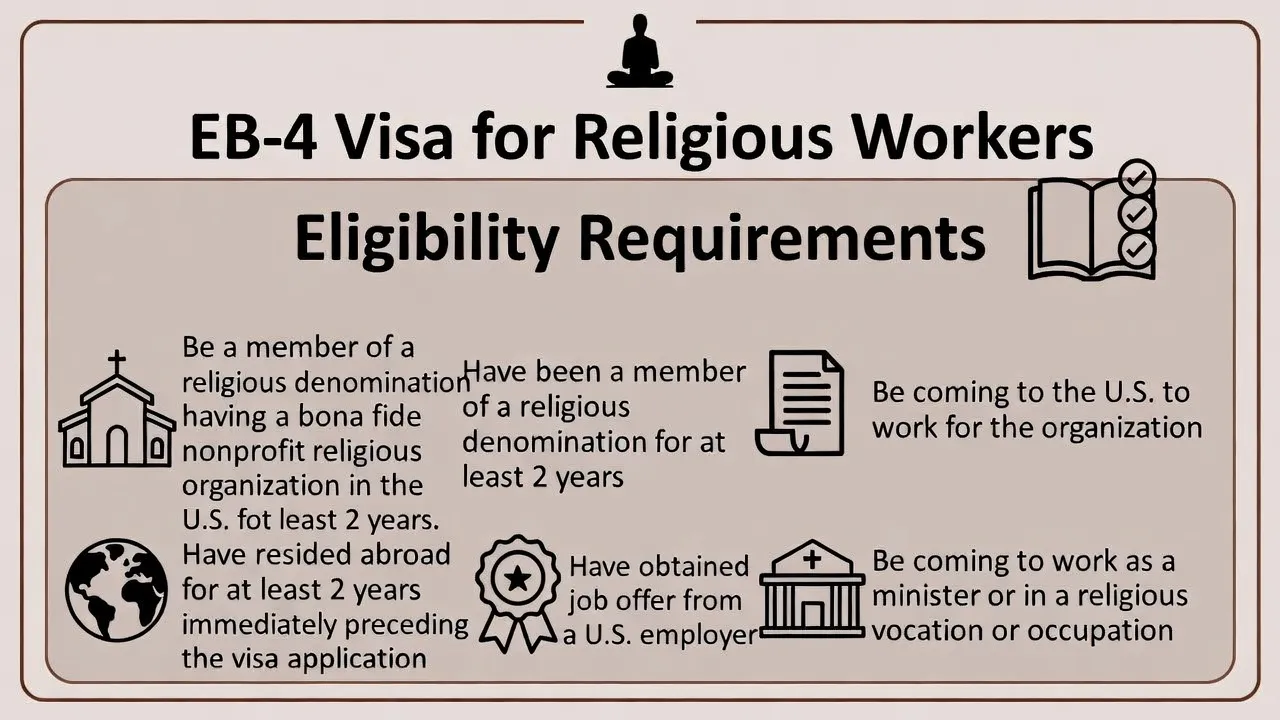
  • You must be a member of your religious denomination for at least 2 continuous years
  • You must have worked in a religious capacity for at least 2 years before applying
  • Full time work of 35+ hours per week is required
  • The religious organization must have IRS 501(c)(3) tax exempt status
  • Form I 360 petition is filed by the employer (or self petitioned by ministers)
  • No labor certification (PERM) is required
  • The non minister religious worker program was extended through January 30, 2027

Who Qualifies for the EB 4 Religious Worker Visa?

The EB 4 category covers three types of religious workers:

1. Ministers of Religion

Ministers are authorized leaders of religious worship within their denomination. They must be:

  • Fully authorized by a recognized religious denomination
  • Able to perform duties normally performed by clergy members
  • Licensed, commissioned, or ordained according to denomination rules

Note: Lay preachers who are not officially recognized by their denomination do not qualify as ministers.

2. Religious Professionals

These are workers performing religious duties that require at least a bachelor’s degree or equivalent. Examples include:

  • Religious teachers
  • Liturgical coordinators
  • Religious counselors with professional degrees

3. Other Religious Workers

This category covers workers in a religious vocation or religious occupation:

Religious vocation means a calling to religious life with lifelong commitment, such as:

  • Monks and nuns
  • Religious brothers and sisters
  • Members of religious orders

Religious occupation means habitual engagement in activities directly related to traditional religious functions, such as:

  • Liturgical workers
  • Religious instructors and counselors
  • Cantors and catechists
  • Missionaries
  • Religious translators
  • Religious broadcasters
  • Workers in religious hospitals or health care facilities
EB 4 Visa for Religious Workers: Complete Eligibility Requirements

Who Does NOT Qualify?

These positions do not meet EB 4 religious worker requirements:

  • Maintenance workers
  • Receptionists and clerical staff
  • Fundraising and development staff
  • Singers (unless performing liturgical duties)
  • Volunteers
  • Workers performing primarily secular functions

Core Eligibility Requirements

RequirementDetails
Membership durationAt least 2 continuous years in the religious denomination
Work experienceAt least 2 years of continuous religious work
Work hoursFull time (35+ hours per week)
CompensationPosition must be compensated (salaried or non salaried)
Organization statusEmployer must have IRS 501(c)(3) tax exempt status
PurposeSingle purpose must be to work in religious capacity

The Two Year Membership Requirement

You must prove continuous membership in your religious denomination for at least two years immediately before filing the petition. This means:

  • Active participation in the religion
  • Documentation of membership (certificates, letters, records)
  • Same denomination as the petitioning organization

The Two Year Work Experience Requirement

You must have worked continuously in a qualifying religious capacity for at least two years:

  • Work can be performed abroad or in the United States
  • Must be the same type of religious work (minister, professional, or other worker)
  • Breaks of less than two years are acceptable if you remained employed as a religious worker

Important: Your previous work does not have to resemble the exact position you will hold after approval, but it must be in a qualifying religious capacity.

Required Documents for EB 4 Religious Workers

Form I 360 Petition

The primary application form is the Form I 360, Petition for Amerasian, Widow(er), or Special Immigrant. This form must include:

Organization Documentation:

  • IRS determination letter confirming 501(c)(3) tax exempt status
  • Documentation of the religious nature and purpose of the organization
  • Organizational literature (books, brochures, calendars) describing religious activities
  • Religious Denomination Certification (part of Form I 360)

Employment Documentation:

  • Employer Attestation (part of Form I 360) signed by authorized official
  • Verifiable evidence of compensation plan (salary, stipend, housing allowance)
  • Organizational charts showing job position
  • Detailed job description showing primarily religious duties

Personal Documentation:

  • Letter from religious organization confirming at least 2 years membership
  • Proof of at least 2 years experience in religious vocation
  • Evidence of religious training and qualifications
  • If minister, proof of authorization and specific duties

Support Letter Requirements

The letter from the religious organization must include:

  • Confirmation of membership for at least two years
  • Documentation of at least two years of work experience
  • Description of the applicant’s religious training
  • Authorization to perform religious duties
  • Details of the specific position being offered
  • Compensation information
EB 4 Visa for Religious Workers: Complete Eligibility Requirements

Application Process Step by Step

Step 1: Employer Files Form I 360

The religious organization files Form I 360 with USCIS. In most cases, the employer must file, but ministers can self petition in certain situations.

Step 2: USCIS Reviews the Petition

USCIS reviews all documentation and may:

  • Request additional evidence (RFE)
  • Conduct a site visit to verify the organization
  • Audit records of the religious organization

Step 3: Receive I 797 Approval Notice

When USCIS approves the petition, they issue a Form I 797 Approval Notice. This notice includes your priority date, which determines your place in line.

Step 4: Wait for Priority Date to Become Current

Due to annual visa limits (approximately 10,000 EB 4 visas per year), you may need to wait. Check the monthly Visa Bulletin to see when your priority date is current.

Step 5: File for Green Card

Once your priority date is current, you can either:

  • Adjustment of Status (Form I 485): If you are in the US
  • Consular Processing: If you are outside the US

EB 4 vs R 1 Visa Comparison

Many religious workers start on an R 1 temporary visa before applying for the EB 4 green card:

FeatureR 1 VisaEB 4 Visa
TypeTemporary (nonimmigrant)Permanent (immigrant)
DurationUp to 5 years totalPermanent residence
Annual limitUnlimited~10,000 visas
Work requirementReligious workFull time religious work (35+ hours)
Experience needed2 years membership2 years membership AND 2 years work
Family benefitsR 2 dependents cannot workDependents get green cards and can work
Processing time~18 months fasterLonger due to backlogs

Current Processing Times and Backlogs

The EB 4 category has experienced significant delays:

  • In April 2025, all EB 4 visas were exhausted for fiscal year 2025
  • Processing resumed October 1, 2025, with the new fiscal year
  • Religious workers on R 1 visas often reach their 5 year maximum while waiting for EB 4 approval

Recent Policy Changes

In January 2026, USCIS published an Interim Final Rule to help religious workers who exhaust their R 1 time while waiting for EB 4 processing. This rule provides relief by allowing certain extensions.

Non Minister Program Extension

The Non Minister Special Immigrant Religious Worker Program (for religious workers who are not ministers) was set to expire but has been extended through January 30, 2027.

Critical Note: Ministers are not affected by this sunset date and can continue to apply indefinitely. The expiration only affects the “other religious workers” category.

Frequently Asked Questions

What are the eligibility requirements for EB 4 religious worker visa?You must be a member of a religious denomination for at least 2 continuous years and have 2 years of work experience in a religious capacity. The position must be full time (35+ hours per week), compensated, and with a nonprofit religious organization having IRS 501(c)(3) status.

How long does the EB 4 religious worker visa take?Processing times vary significantly due to annual visa limits and backlogs. The I 360 petition takes several months, but waiting for a visa number can take years depending on demand. Check the monthly Visa Bulletin for current wait times.

Can I self petition for an EB 4 religious worker visa?Ministers can self petition in certain situations. However, most religious workers must have their employer (the religious organization) file the I 360 petition on their behalf.

What is the difference between R 1 and EB 4 visa?The R 1 is a temporary visa allowing up to 5 years of religious work, while the EB 4 leads to permanent residence (green card). The EB 4 requires full time work and 2 years of work experience, while the R 1 has more flexibility.

Does EB 4 require labor certification?No. The EB 4 religious worker category does not require labor certification (PERM). This makes the process simpler than most employment based green card categories.

Can my family get green cards through EB 4?Yes. Your spouse and unmarried children under 21 can apply for green cards as derivatives under your EB 4 petition. They will receive permanent resident status when you do.

Helpful Resources

For official information about the EB 4 religious worker visa, visit these websites:

  • USCIS at uscis.gov for Form I 360 and filing instructions
  • US State Department at travel.state.gov for Visa Bulletin and consular processing
  • CLINIC at cliniclegal.org for religious immigration resources

Work with an experienced immigration attorney familiar with religious worker visas. The documentation requirements are specific, and proper preparation helps avoid delays and requests for additional evidence.

Related Articles

Get visa, passport, and travel-planning guides like this one sent straight to your inbox — plus first access to new country guides and scholarship roundups.


One Visa Center Editorial Team

aOne Visa Center's editorial team researches and fact-checks every guide against official government sources -- national immigration and passport authorities, embassy and consular pages, and agencies like USCIS, the U.S. State Department, and TSA -- before publishing. Guides are reviewed and updated as rules change (fees, processing times, and eligibility criteria are checked against the official source cited in each article). Have a correction or a question about a specific post? Reach the team at [email protected].

close