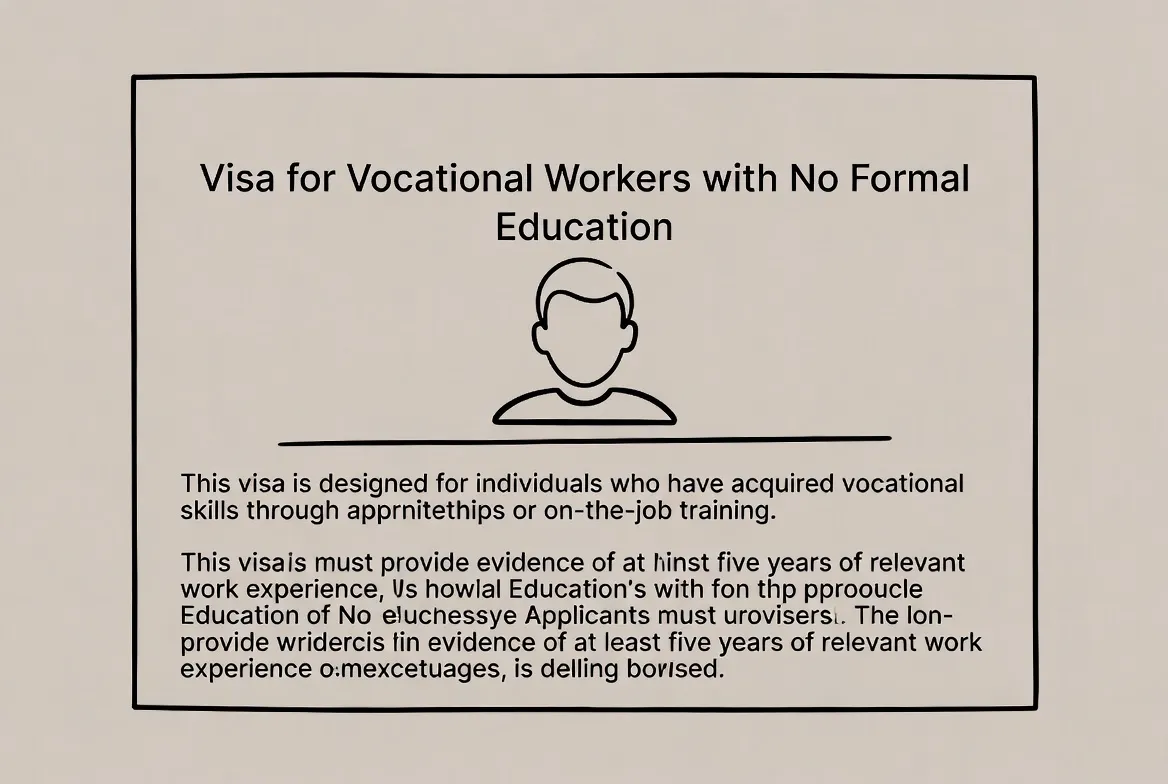

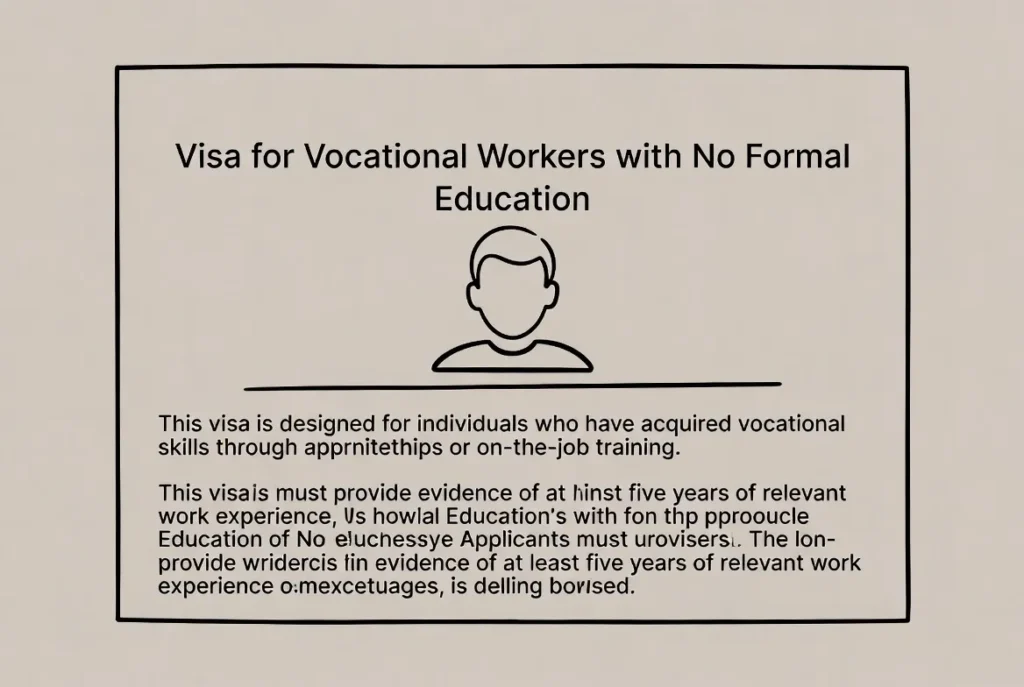
For many skilled workers globally, extensive practical experience, rather than formal education, defines their career. The challenge for these individuals is finding a legal pathway to work in the United States, as many popular employment visas, such as the H-1B, require a bachelor’s degree.1
Fortunately, there is a specific non-immigrant visa designed for temporary employment in jobs that often rely on practical skill over academic certification.2 This article will focus on the H-2B Temporary Non-Agricultural Worker Visa as the primary solution for individuals with strong vocational skills but no basic education seeking temporary US employment.
The Visa Solution: The H-2B Temporary Worker Visa
The H-2B Visa is a non-immigrant visa that allows US employers to bring foreign nationals to the United States to fill temporary non-agricultural jobs.3 This is the critical distinction that makes it suitable for skilled trades and vocational workers without a high school diploma or equivalent.
The focus of the H-2B is on the temporary need of the employer and the worker’s ability to perform the job, not their academic history.
Key Visa Type: H-2B Temporary Non-Agricultural Worker Visa
Suitable Vocations:
The H-2B visa is commonly used in industries such as:
- Construction: Specialized framers, roofers, dry-wall installers, or masonry workers.4
- Hospitality/Tourism: Cooks, resort staff, and specialty cleaners.5
- Landscaping: Grounds maintenance, irrigation specialists, or tree trimmers.
- Seafood Processing and other temporary manufacturing.6
Requirements for the H-2B Visa Pathway
The entire H-2B immigration process is employer-driven, meaning the individual cannot apply without a job offer.7 The burden of proof rests primarily on the US company (the petitioner).8
1. The Temporary Job Offer
- The job must be non-agricultural (agricultural jobs use the H-2A visa).9
- The work must be temporary, seasonal, intermittent, or due to a peak load.10 The need cannot be permanent.
- The duration is typically up to one year, with potential extensions up to a maximum stay of three years.11
2. Employer Requirements (Labor Certification)
The US employer must first prove to the Department of Labor (DOL) that:
- There are not enough US workers who are able, willing, qualified, and available to do the temporary work.12
- Hiring the foreign worker will not adversely affect the wages and working conditions of similarly employed US workers.13
- The employer must file and receive a Temporary Labor Certification from the DOL.14
3. Worker Requirements (Focus on Vocational Skill)
While the H-2B visa does not impose a minimum education requirement, the worker must still:
- Be a national of a country designated by the Department of Homeland Security (DHS) as eligible for the program.15
- Have a valid job offer in writing.
- Meet the minimum qualifications required for the specific position, which means providing strong proof of vocational experience (letters from former employers, portfolios, testimonials, or specialized certifications).16
- Demonstrate nonimmigrant intent (intent to return to their home country upon the visa’s expiration).17
Step-by-Step Process for Securing H-2B Employment
The process for obtaining the H-2B visa is a collaboration between the US employer and the foreign worker.18
| Phase | Description | Key Action |
| Step 1: Job Search | Worker seeks out US employers known to hire H-2B temporary workers or that openly advertise US visa sponsorship. | Secure a definitive written job offer in a skilled trade. |
| Step 2: DOL Certification | The employer files the Temporary Labor Certification with the DOL to prove the need and the lack of US workers. | Worker prepares documentation of their years of vocational experience for the employer to use as evidence. |
| Step 3: USCIS Petition | Once the DOL approves the labor certification, the employer files Form I-129 (Petition for a Nonimmigrant Worker) with the USCIS. | Worker awaits the USCIS approval, evidenced by Form I-797 (Notice of Action) sent to the employer. |
| Step 4: Visa Application | The worker applies for the H-2B visa at a US Embassy or Consulate in their home country. | Complete Form DS-160 (Online Nonimmigrant Visa Application) and schedule the consular interview. |
| Step 5: Consular Interview | The final stage, where the Consular Officer verifies the worker’s intent and qualifications. | Present the approved Form I-797 and evidence of ties to the home country (nonimmigrant intent). |
This specialized temporary work visa offers a critical avenue for experienced individuals whose credentials lie in practical skill, not academic degrees.
- H-2B Visa: The specific visa type for temporary, non-agricultural employment.19
- No Basic Education Requirement: Highlighted advantage for this visa category.
- Vocational Skills: The core qualification required for the job.
- Temporary Work Visa: Defines the non-immigrant nature of the stay.20
- US Visa Sponsorship: The necessity of securing an employer to initiate the process.
- Skilled Trades: The type of job roles typically filled (e.g., construction, hospitality, landscaping).21
- USCIS/DOL: The government bodies involved in the petition process.
Successfully navigating the H-2B immigration route allows experienced, non-degreed skilled tradesmen the chance to legally work and travel in the USA, contributing their vocational expertise to US industries with temporary labor shortages.
Related Articles
- Cayman Visa Requirements: Simple Step By Step Guide
- Qatar Airways Visa Requirements: Clear Guide For 2026 Travelers
- How To Migrate To Canada As An Agricultural Worker From Africa
Get visa, passport, and travel-planning guides like this one sent straight to your inbox — plus first access to new country guides and scholarship roundups.