
Last checked against official sources: October 5, 2026
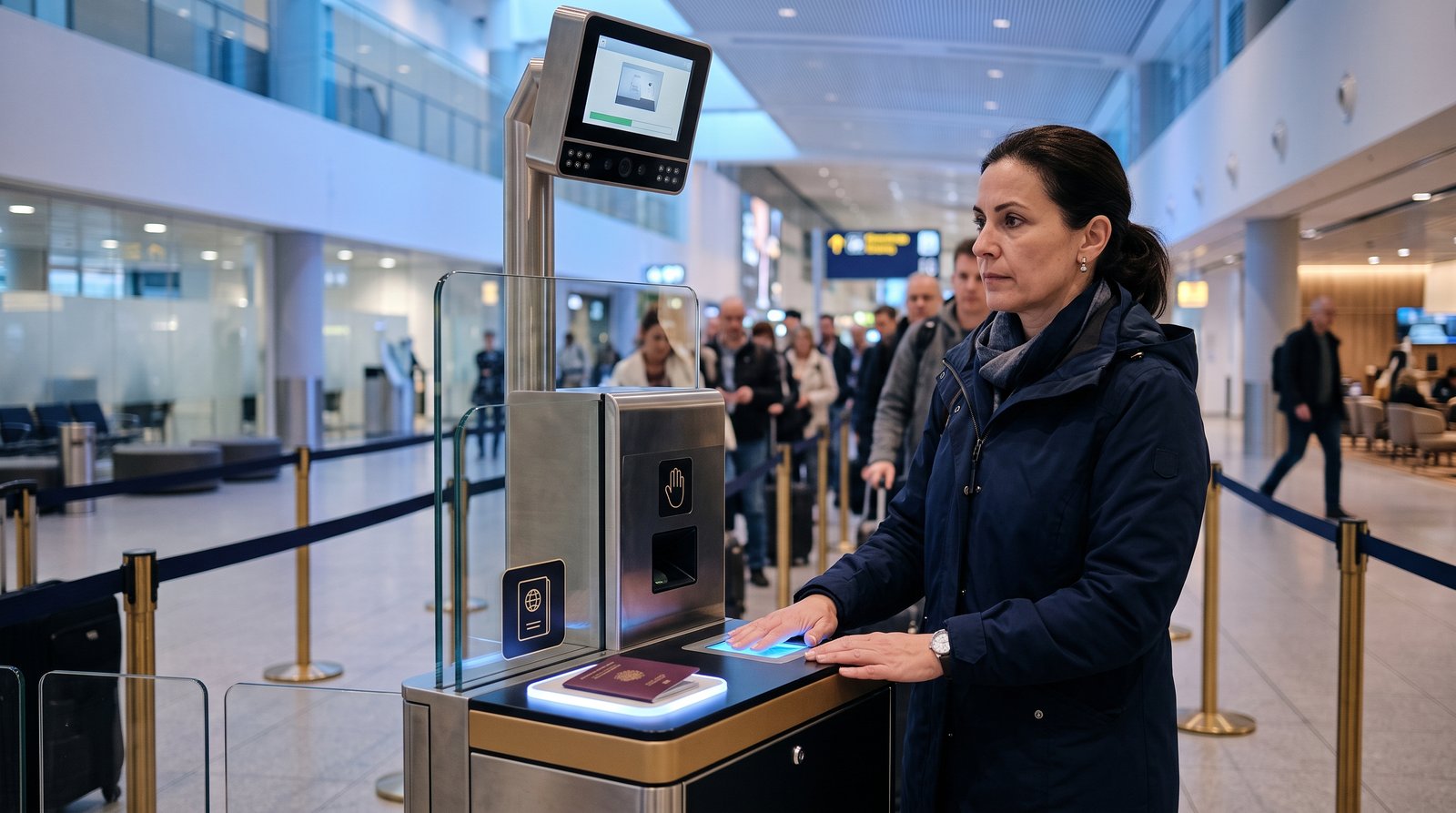
If you’re not an EU citizen and you’ve visited Europe recently, you may have noticed the passport stamp is gone. Instead, a border officer or self-service kiosk took your fingerprints and a photo of your face. That’s the Entry/Exit System (EES). It started a gradual rollout on October 12, 2025 and became fully operational on April 10, 2026.
Here’s what EES means for your trip, and what it doesn’t.
What EES is (in plain English)
EES is a shared digital register used at the external borders of 29 European countries. That’s the 25 EU countries in the Schengen area plus Iceland, Liechtenstein, Norway and Switzerland. Cyprus and Ireland don’t use it.
At the border it records:
- your name and passport details
- your fingerprints and a facial image
- the date and place of every entry and exit
- any refusal of entry
It replaces manual passport stamping. Your stay is calculated automatically against the Schengen 90/180-day rule.
Who has to register?
You go through EES if you’re a non-EU national on a short stay (up to 90 days in any 180-day period). That includes:
- Visa-free travellers, such as citizens of the US, UK, Canada and Australia
- Short-stay Schengen visa holders, such as travellers from Ghana, Nigeria and India
You generally don’t go through EES if you are:
- an EU, EEA or Swiss citizen
- a holder of a residence permit or long-stay (type D) national visa for a Schengen country
- a family member of an EU citizen with a residence card under EU free-movement rules
- a diplomat with accredited status
Children under 12 don’t give fingerprints, but their facial image and passport details are still recorded.
What happens at the border
First trip after EES started:
- At passport control, an officer or a self-service kiosk scans your passport.
- You give four fingerprints and a facial image. Some kiosks also ask a few questions, such as where you’re staying.
- The officer checks your documents and records your entry.
Later trips: Your record already exists, so usually only a face check or fingerprint check is needed. Many travellers can use automated e-gates.
If you refuse to give biometric data, you’ll be refused entry.
How long is your data kept?
- Normally 3 years from each entry or exit record
- 5 years from your last exit if you overstayed, or if there’s no exit record
This is why overstays matter more than before. The system flags them automatically, and future border officers and visa officers can see them.
Early results
The European Commission reported that by the end of March 2026, EES had recorded over 45 million border crossings. It had led to over 24,000 refusals of entry, including more than 600 people identified as security risks.
What changed for you in practice
| Before EES | With EES |
|---|---|
| Ink stamps in your passport | Digital record, no stamps |
| Officers counted days by hand | Days counted automatically against 90/180 |
| Overstays were easy to miss | Overstays flagged automatically and kept for 5 years |
| Same process every visit | Longer first registration, faster checks later |
Tips to avoid problems
- Allow extra time on your first crossing. This matters most at busy hubs, ferry ports and coach terminals, where registration can add to queue times.
- Count your days honestly. Use the 90/180 rule. EES will catch even short overstays.
- Use the same passport you registered with where possible. If you renew your passport, expect to register again.
- Keep your trip documents handy, such as your return ticket, hotel booking and proof of funds. EES doesn’t remove the normal entry checks.
- Coming from the UK? EES checks happen at the “juxtaposed” controls before you leave the UK, for example at Dover, Folkestone and St Pancras (Eurostar). Expect queues there, not on arrival in France.
EES vs ETIAS: they’re not the same
- EES is the biometric border register. It’s live now and free.
- ETIAS is a separate online travel authorisation that visa-free visitors will need before travelling. It’s expected to cost €20, free for under-18s and over-70s. As of October 2026, ETIAS isn’t open for applications and the EU hasn’t confirmed a firm start date. Read our ETIAS guide for the latest.
If a website asks you to pay to “register for EES” before your trip, it’s a scam. There’s no fee and no pre-registration requirement.
Frequently asked questions
Do I still need a Schengen visa?
If your nationality needs one, yes. EES doesn’t replace visas. See our Schengen visa from Ghana guide for the application process.
Will I still get a stamp?
No. Stamping has been replaced by the digital record.
Does EES apply when I enter the UK or Ireland?
No. Neither country uses EES. The UK has its own ETA scheme.
How we researched this
This guide is based on the European Commission (DG Migration and Home Affairs) EES pages and its March 30, 2026 announcement of full operations, EU Regulation 2017/2226 and its 2025 amendment, and travel-industry guidance (ABTA). Border procedures can vary between crossing points, so check the official EU Travel to Europe site before you travel.
One Visa Center is an information site, not a law firm, and this is not legal advice. Read how we research, fact-check and use AI tools in our Editorial Policy.
Get visa, passport, and travel-planning guides like this one sent straight to your inbox — plus first access to new country guides and scholarship roundups.