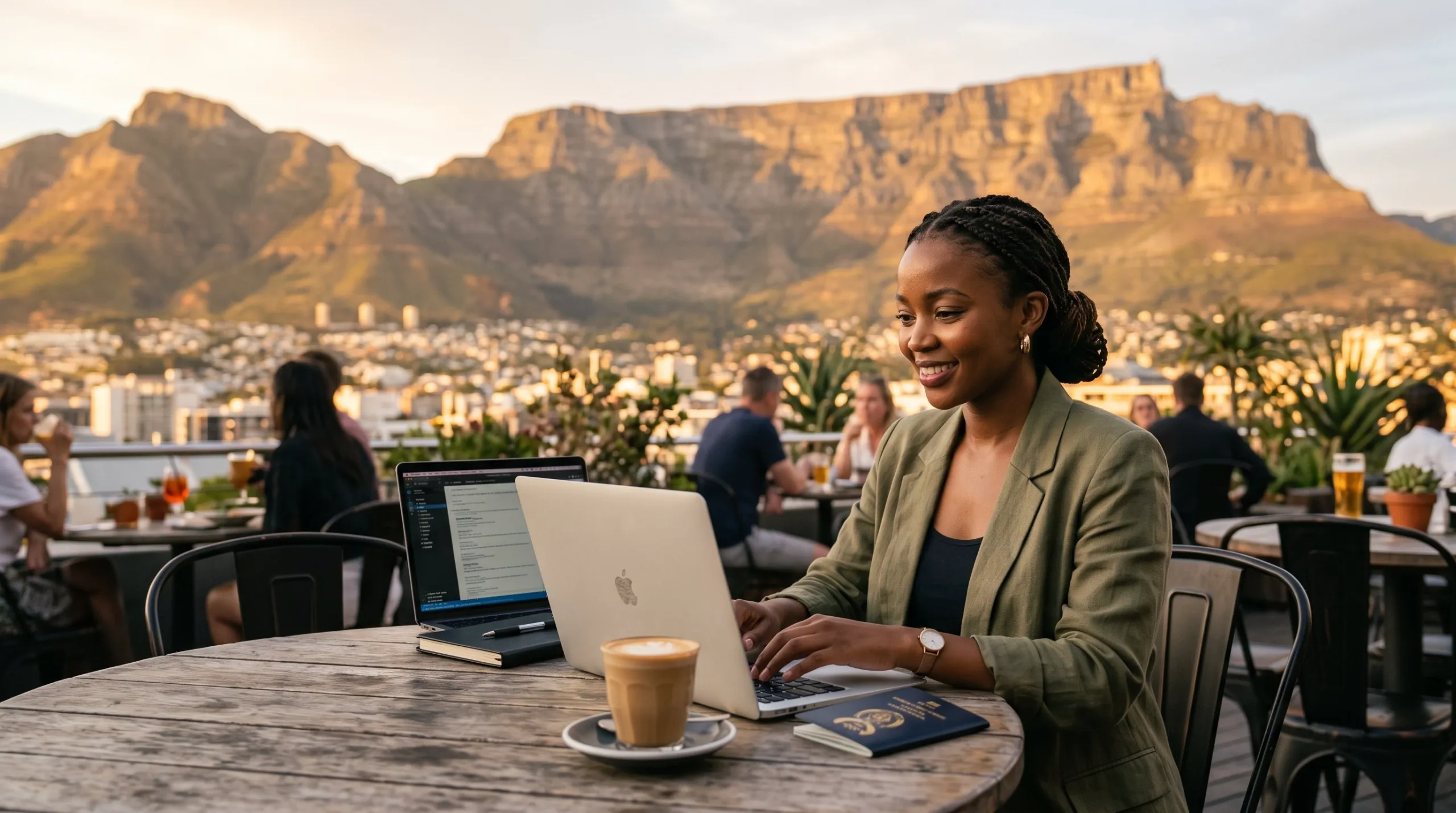

South Africa’s remote work visa (officially issued as an endorsement on the general work visa) lets non-South Africans live in the country for up to three years while working for an employer based outside South Africa. It was one of the most-requested digital nomad visas on the continent, and as of 2026 the application pathway is fully operational through South African missions and VFS Global centers. Here’s exactly who qualifies, what it costs, and how to apply without the trial and error.
Who Qualifies for the South Africa Digital Nomad Visa
Unlike a dedicated “digital nomad visa” category, South Africa built this into its existing General Work Visa as a remote-work endorsement. To qualify, you need to show:
- An employment contract or proof of self-employment with a company registered outside South Africa
- Annual income above the published threshold (see table below)
- A valid passport with at least 30 days’ validity beyond your intended stay
- Proof of medical insurance covering your time in South Africa
- A police clearance certificate from every country you’ve lived in for 12+ months over the past decade
Income Requirement and Fees
| Requirement | Detail |
|---|---|
| Minimum annual income | Approx. ZAR 1 million (roughly USD 55,000) — confirm the current published figure with your nearest South African mission before applying, as it is adjusted periodically |
| Maximum stay | Up to 3 years, renewable |
| Tax registration | Required only if you stay long enough to trigger South African tax residency (generally 183+ days in a 12-month period) |
| Where to apply | VFS Global visa facilitation center or South African embassy/consulate in your home country |
If you’re comparing South Africa against other remote-work destinations before committing, our Digital Nomad Visa Toolkit walks through a 25-country income and tax comparison so you can see how South Africa’s threshold stacks up before you gather documents.
Step-by-Step Application Process
- Gather your proof-of-income documents — employer letter, last 3-6 months of pay slips or invoices, and bank statements showing consistent deposits.
- Get a police clearance certificate from each country you’ve lived in for a year or more in the last 10 years. This step alone can take 8-12 weeks in some countries, so start it first.
- Take out medical insurance that explicitly covers South Africa for the full duration requested.
- Book your VFS Global appointment and submit biometrics along with your documents.
- Wait for adjudication — processing commonly runs 6-12 weeks, though it varies by mission.
Common Reasons Applications Get Delayed
The most frequent hold-up isn’t income — it’s the police clearance certificate. Applicants who wait until the rest of their file is ready before requesting clearances routinely lose two to three months. The second most common issue is an employment letter that doesn’t explicitly confirm the role is fully remote and the employer has no South African operations; immigration officers look for this distinction specifically because the visa exists to bring in foreign-earned income without displacing local jobs.
Frequently Asked Questions
Can I bring my family on a South Africa digital nomad visa?
Yes — spouses and dependent children can generally apply for accompanying visas, though each dependent needs their own supporting documents, including medical insurance and, in most cases, their own police clearance certificates if over the age of majority.
Do I have to pay South African tax on foreign income?
Only if you become a South African tax resident, which generally requires spending 183+ days in the country within a 12-month period (with additional day-count tests for ordinarily-resident status). Many remote workers structure their stay to stay under this threshold; if that’s your plan, confirm the exact rule with a South African tax advisor before you travel, since day-counting rules are strict and unforgiving.
Can I convert this visa into permanent residency later?
The remote-work endorsement itself doesn’t lead directly to permanent residency, since it’s tied to foreign employment rather than a South African employer or investment. Long-term residents typically need to switch to a different visa category (such as a critical skills or business visa) if permanent residency is the eventual goal.
Related reading: The World’s Strongest (and Weakest) Passports in 2026 · The Digital Nomad Visa Toolkit
Official sources to check before you apply or travel
- GOV.UK foreign travel advice (entry requirements by country)
- Government of Canada travel advice and advisories
Visa rules, fees, processing times and entry requirements change often. Always confirm the current requirements on the official government website, or with the embassy or consulate, before you apply, pay or travel. One Visa Center is an independent information site, not a law firm or government agency, and this article is not legal advice. Read how we research, fact-check and use AI tools in our Editorial Policy.
Get visa, passport, and travel-planning guides like this one sent straight to your inbox — plus first access to new country guides and scholarship roundups.