
Good news for American travelers! You do not need a visa to visit Ecuador. US passport holders can enjoy up to 90 days of visa free travel per 12 month period for tourism and business purposes.
Do US Citizens Need a Visa for Ecuador?
No, United States citizens do not need a visa to enter Ecuador for short stays. Upon arrival, you will receive a T3 passport stamp that allows you to stay for up to 90 days per calendar year without any visa paperwork.
This visa free policy covers:
- Tourism and vacation travel
- Business trips and meetings
- Visiting friends and family
- Short term educational activities
Key Point: While you can stay 90 days without a visa, you have the option to extend your stay for an additional 90 days by applying for an extension between days 80 and 90 of your initial stay.
Passport and Entry Requirements
Even without a visa, you must meet specific requirements to enter Ecuador. Immigration officers check these items carefully at the airport.
Passport Rules
| Requirement | Details |
|---|---|
| Passport validity | Must be valid for at least 6 months beyond arrival date |
| Blank pages | At least 1 blank page for entry and exit stamps |
| Condition | Must be undamaged and readable |
Documents to Bring
You should carry these items when entering Ecuador:
- Valid US passport meeting the requirements above
- Proof of return or onward travel (flight ticket)
- Evidence of accommodation (hotel booking or address)
- Proof of sufficient funds for your stay
Immigration officers may ask to see any of these documents, so keep them easily accessible during your arrival.
Special Rules for Galapagos Islands
Planning to visit the famous Galapagos Islands? There are extra requirements beyond mainland Ecuador entry rules.
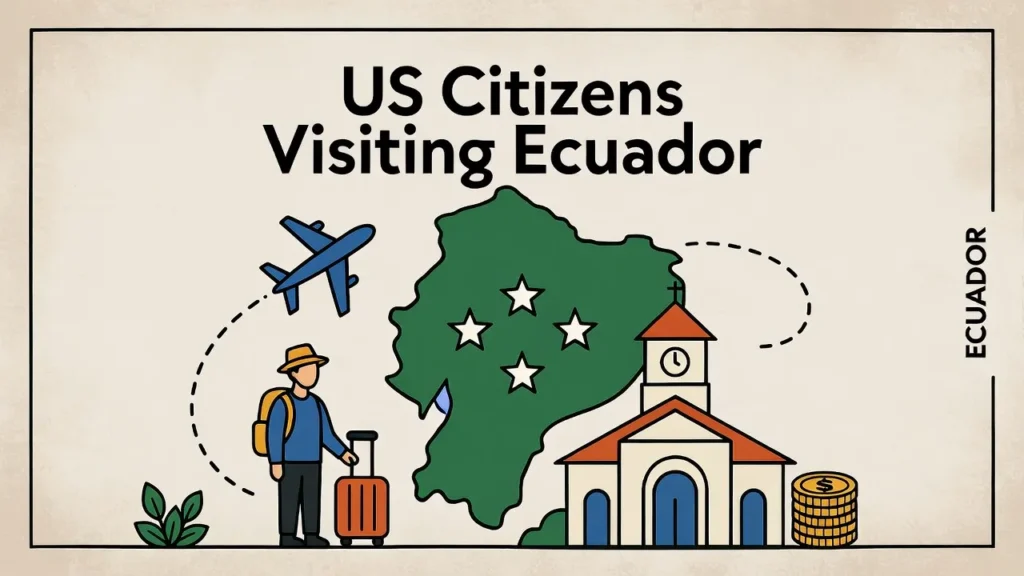
Transit Control Card (TCT)
Every visitor to the Galapagos must obtain a Transit Control Card (TCT) regardless of nationality. This card helps the government track visitor numbers to protect the fragile ecosystem.
How to get your TCT:
- Complete the online registration before your trip (available since May 2025)
- Pay the $20 fee per person
- Keep the card safe as you need it for entry and exit from the islands
You can also obtain the TCT at the Galapagos Immigration offices located at Quito and Guayaquil airports.
Galapagos National Park Entrance Fee
| Visitor Category | Fee |
|---|---|
| International visitors 12 years and older | $200 |
| International children under 12 | $100 |
| South American community members over 12 | $100 |
| South American community members under 12 | $50 |
Important: You must pay this fee in cash at the Galapagos airport upon arrival. Credit cards (Visa and Mastercard only) are now accepted, but debit cards are not.
Maximum Stay in Galapagos
The maximum allowed tourist stay in the Galapagos Islands is 60 days per calendar year, which cannot be extended. This is separate from your 90 day mainland Ecuador allowance.
How to Extend Your Stay Beyond 90 Days
Want to stay longer in Ecuador? You can apply for a one time extension that adds another 90 days to your allowed stay.
Extension Process
- Apply between day 80 and day 90 of your stay
- Visit a National Support Service Unit for Migration
- Pay a fee equal to one third of Ecuador’s basic salary (approximately $160 USD)
- Provide a valid passport and proof of payment
What Happens If You Overstay
If you exceed the 90 day limit without an extension, you face penalties:
- You have 30 additional days to request a late extension
- You must pay a fine equal to 50% of the Unified Basic Salary (around $235)
- The overstayed days are deducted from your extended allowance
- Extensions are only granted once per calendar year
Ecuador Uses the US Dollar
Great news for American travelers! Ecuador adopted the US dollar as its official currency in 2000. This makes money matters simple for US visitors.
Money Tips for Your Trip
Pro Tip: Many businesses in Ecuador call $50 and $100 bills “billetes feos” (ugly bills) and may refuse them. Stick to smaller denominations for smooth transactions.
Tipping Guidelines
Tipping is appreciated but not always expected in Ecuador:
- Restaurants: 10% of the bill (15 to 20% for exceptional service)
- Hotel staff: $1 to $2 per service
- Tour guides: $5 to $10 per day
- Taxi drivers: Round up to the nearest dollar
Best Time to Visit Ecuador
Ecuador offers diverse climates across its regions, so the best time depends on where you plan to go.
Seasonal Overview
For the Highlands and Quito: The driest months are June through September, though the subtropical climate means pleasant weather year round with temperatures around 19°C (66°F).
For the Coast: December through May brings sunny weather and warm ocean temperatures perfect for beach activities.
For the Galapagos: Every month offers unique wildlife experiences. The warmer season (December to May) brings calmer seas and better snorkeling visibility.
Arriving at Ecuador’s Airports
Most international visitors arrive at one of Ecuador’s two main airports.
Quito’s Mariscal Sucre International Airport (UIO)
This is one of the busiest airports in Latin America. It sits about 23 miles (37 km) outside the city, which means a 45 minute drive to downtown Quito.
Direct flights available from: Miami, Houston, Atlanta, New York City, Fort Lauderdale, Dallas, Madrid, and Amsterdam.
Guayaquil’s Jose Joaquin de Olmedo International Airport (GYE)
Located conveniently near the city center, this recently remodeled airport handles many domestic and international flights. If you plan to visit the Galapagos immediately, fly into Guayaquil since most island flights depart from here.
What to Expect at Immigration
- Exit the plane and follow signs to immigration
- Present your passport to the immigration officer
- Answer questions about your trip purpose and accommodation
- Receive your T3 entry stamp
- Collect your baggage
- Pass through customs (you can bring personal items, up to 3 liters of alcohol)
Safety Tips for US Travelers
Ecuador is generally safe for tourists, but you should take standard precautions.
Stay Safe By Following These Guidelines
- Be aware of your surroundings at all times
- Avoid carrying large amounts of cash or showing expensive jewelry
- Use official taxi stands or ride hailing apps, especially at night
- Keep valuables secure and out of sight on public transportation
- Avoid walking alone at night in unfamiliar areas
- Ask hotel staff about safe neighborhoods to visit
Areas to Avoid
- High crime neighborhoods on the outskirts of Quito and Guayaquil
- Border areas near Colombia
- Remote regions with limited infrastructure
Dual Citizens: Special Considerations
If you hold both US and Ecuadorian citizenship, there are important rules to know:
- You may enter Ecuador with your Ecuadorian passport if your US passport lacks six months validity
- If you enter as a dual national, you must also depart as a dual national
- You will need to show both passports at immigration
- While in Ecuador, your Ecuadorian citizenship takes priority over your US citizenship
Frequently Asked Questions
How long can US citizens stay in Ecuador without a visa?
US citizens can stay up to 90 days per 12 month period without a visa for tourism or business purposes. You can extend this by another 90 days with proper application.
Do I need travel insurance for Ecuador?
Travel insurance is not mandatory but highly recommended. It helps cover medical emergencies, trip cancellations, and unexpected situations during your visit.
Can I work in Ecuador as a tourist?
No. The tourist entry permit prohibits any paid work or local labor activities. You must obtain proper work authorization through the appropriate visa category to work legally.
What vaccines do I need for Ecuador?
No vaccines are required for entry from the United States. However, the CDC recommends being up to date on routine vaccinations. Yellow fever vaccination is recommended if visiting the Amazon region.
Is the Galapagos National Park fee included in tour packages?
Usually no. The $200 entrance fee and $20 TCT card must be paid separately upon arrival at the Galapagos airport. Some tour operators may assist with the payment process but the fees remain your responsibility.
Can I use credit cards in Ecuador?
Credit cards are accepted in major cities, hotels, and tourist areas. However, smaller shops, markets, and rural areas prefer cash. Always carry small bills for everyday purchases.
Key Takeaways
- No visa required for US citizens visiting Ecuador for up to 90 days per 12 month period
- Passport validity must be at least 6 months beyond your arrival date
- Galapagos visitors need a TCT card ($20) and must pay the National Park entrance fee ($200 for adults) in cash
- Maximum Galapagos stay is 60 days per calendar year, non extendable
- Ecuador uses US dollars so no currency exchange is needed for American travelers
- Carry small bills as $50 and $100 notes are often refused
- Best time to visit is June through September for dry weather in the Highlands
- Extension possible by applying between days 80 and 90 of your initial stay
Related Articles
- China Visa-Free Entry 2026: Full 50-Country List & Rules
- Visa-Free Countries for Nigerian Passport (2026 List)
- Visa-Free Countries for Ghana Passport Holders (2026)
Official sources to check before you apply or travel
- U.S. State Department travel advisories
- GOV.UK foreign travel advice (entry requirements by country)
Visa rules, fees, processing times and entry requirements change often. Always confirm the current requirements on the official government website, or with the embassy or consulate, before you apply, pay or travel. One Visa Center is an independent information site, not a law firm or government agency, and this article is not legal advice. Read how we research, fact-check and use AI tools in our Editorial Policy.
Get visa, passport, and travel-planning guides like this one sent straight to your inbox — plus first access to new country guides and scholarship roundups.