
If you want to live in Portugal and run a business or work as a freelancer, the D2 visa can be a great path.
The Portugal D2 visa is for entrepreneurs, freelancers and independent professionals who want to live in Portugal and run a real, sustainable business. You must show a clear business plan, enough money to live, and basic documents like a passport, clean criminal record, health insurance and proof of a place to stay.
Key Takeaways
- The D2 visa is for people who want to start or move a business or work as a freelancer in Portugal.
- You need a strong business plan that shows your activity is useful and sustainable in Portugal.
- You must prove financial means, usually at least about 11,000 to 12,000 euros for one adult, plus extra for family members.
- Required documents include passport, criminal record certificate, health insurance, proof of accommodation, Portuguese tax number (NIF) and bank account.
- After the visa, you apply for a residence permit in Portugal and can later apply for permanent residence or citizenship if you meet all rules.
What Is the Portugal D2 Visa?
The Portugal D2 visa is often called the Entrepreneur Visa or Immigrant Entrepreneur Visa. It is made for non‑EU and non‑EEA citizens who want to open or move a business, or work as independent professionals, in Portugal.
It is different from the D7 visa, which is for people with passive income, and from the Startup Visa, which targets innovative tech startups. With the D2, the focus is on real business activity and value for the Portuguese economy.
Who Can Apply?
In general, you can apply for the D2 visa if you:
- Are at least 18 years old.
- Hold a valid passport.
- Are from outside the EU, EEA and Switzerland.
- Plan to start or run a business or work as a freelancer in Portugal.
- Can prove you have enough money to live in Portugal and support any dependents.
- Have a clean criminal record and are not a security risk.
Typical applicants include:
- Small business owners opening a branch in Portugal.
- Freelance developers, designers or consultants with clients in or linked to Portugal.
- Professionals planning to set up a local service business, such as a café, agency or studio.
Core D2 Visa Requirements
1. Business Plan and Business Setup
A solid business plan is one of the most important parts of the D2 visa.
Your plan should clearly show:
- The type of business or freelance activity
- Target clients and market in Portugal
- Revenue model and expected income
- Job creation or other benefits for Portugal
- Investment you will make and how you will fund it
Many guides note that there is no fixed minimum investment, but small businesses often start with share capital of around 5,000 euros.
If you are a freelancer, you may also need:
- Signed service contract or letters of intent from Portuguese or international clients
- Proof of professional qualifications where needed (for example, regulated professions)
2. Financial Proof
You must show that you can support yourself and your family in Portugal without relying on local social support.
Different sources give similar guidance:
- Around 11,000 to 12,000 euros for the main applicant for one year.
- About half of that amount for a spouse, and around 30 percent for each child, often linked to the Portuguese minimum wage.
You can prove this with:
- Bank statements
- Proof of savings or investments
- Regular income statements
- Signed contracts showing future income
3. Documents Checklist
You will usually need:
- Valid passport, valid at least several months beyond visa end date.
- Two recent passport photos.
- Criminal record certificate from every country where you have lived for more than 1 year, issued within about 3 months.
- Health or travel‑medical insurance covering Portugal and often the EU.
- Proof of accommodation in Portugal, such as a rental contract or property deed.
- Portuguese NIF (tax number).
- Portuguese bank account with enough funds for your stay.
- Business plan and, if already available, company registration documents in Portugal.
- Declaration explaining why you want to live in Portugal and your project.
Some consulates may ask for extra items, so always check the official consulate website in your home country.
4. First Visual Overview
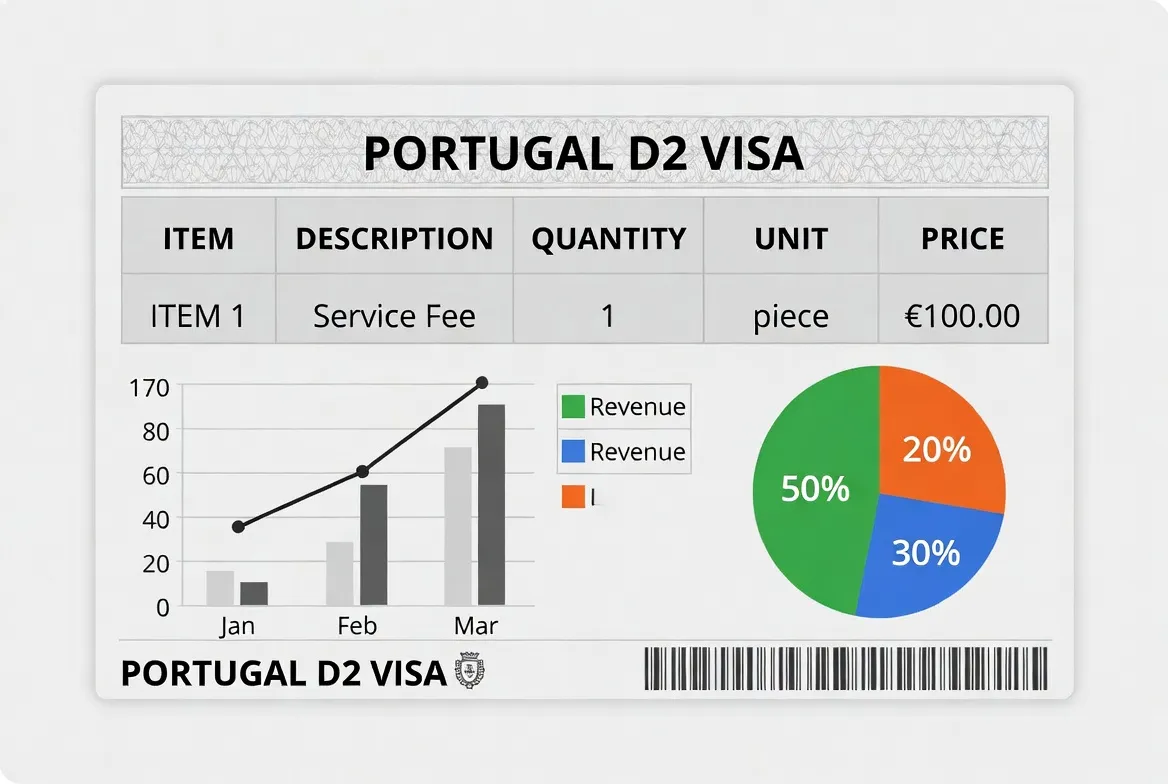
Below is a simple table that shows key elements of the D2 visa at a glance.
The image above can help you picture the basic path from planning your business to getting your residence card in Portugal.
D2 Visa Main Elements Table
| Element | What It Means |
|---|---|
| Target applicant | Entrepreneur, freelancer, independent professional |
| Business plan | Shows business model, value to Portugal, viability |
| Investment | No fixed minimum, often around 5,000 euros share capital |
| Financial means | About 11,000–12,000 euros for main applicant, more for family |
| Key documents | Passport, criminal record, insurance, housing proof, NIF, bank account |
| After arrival | Residence permit application with immigration authority |
Step by Step: How to Apply
Step 1: Prepare Your Project
- Decide if you will be a company owner or a freelancer in Portugal.
- Write a clear business plan in simple language, with numbers and goals.
- Collect contracts or letters of intent from clients if you are a freelancer.
Step 2: Get NIF and Bank Account
Before or during your application, you usually need to:
- Apply for a Portuguese NIF (tax ID).
- Open a Portuguese bank account and deposit the recommended funds.
Some service companies or lawyers can act as your tax representative and help with this part.
Step 3: Secure Accommodation
You must show where you will live when you arrive in Portugal.
This can be:
- A rental contract for several months
- A property deed if you bought a home
- Sometimes a booking or hosting agreement, depending on the consulate rules
Step 4: Collect All Documents
Gather all documents listed in the checklist and check that:
- Names and dates match on all papers
- Criminal record certificates are recent
- All foreign documents are translated and legalized if needed
Step 5: Submit at the Portuguese Consulate
- Book an appointment with the Portuguese consulate or visa center in your country.
- Bring all original documents and copies.
- Pay the visa fee and complete the visa form.
If approved, you get a D2 visa sticker in your passport that lets you travel to Portugal for residence purposes.
Step 6: Residence Permit in Portugal
After you arrive:
- Attend your appointment with AIMA (the immigration authority).
- Present updated documents such as proof that the company has been formally created, social security registration and local criminal record clearance.
- Provide biometrics (photo and fingerprints).
If all is in order, you receive a residence card, usually valid for 2 years, which you can later renew.
Costs and Financial Planning
While there is no fixed legal minimum investment for the D2 visa, you should plan for:
- Share capital and startup costs, often from 5,000 euros or more for a small business.
- Living costs, with at least 11,000 to 12,000 euros for one adult per year recommended, and extra for each family member.
- Rent or housing costs depending on the city; larger cities like Lisbon and Porto are usually more expensive.
- Health insurance and visa fees.
It is wise to have a buffer above the minimum amounts so that your application looks stronger and you feel safer once you move.
Benefits of the Portugal D2 Visa
The D2 visa offers several useful benefits for long‑term planners.
- Legal residence in an EU country with good quality of life.
- Right to live and work in Portugal in your own business or freelance activity.
- Family reunification for spouse and dependent children, if you meet the financial rules.
- Access to public healthcare after you get your residence card and register.
- Path to permanent residence and citizenship after several years, if you meet stay rules and language level.
Practical Example: Simple D2 Plan
Here is a basic example of how someone might use the D2 visa:
“I am a freelance web developer with clients in Europe. I open a Portuguese company, deposit 6,000 euros as share capital, show 15,000 euros in savings, sign a one‑year rental contract in Porto and present contracts with two clients. I apply for the D2 visa with a clear business plan showing my expected income and how I will grow in Portugal.”
This kind of clear, focused story helps consular officers understand your project and see that it is real and sustainable.
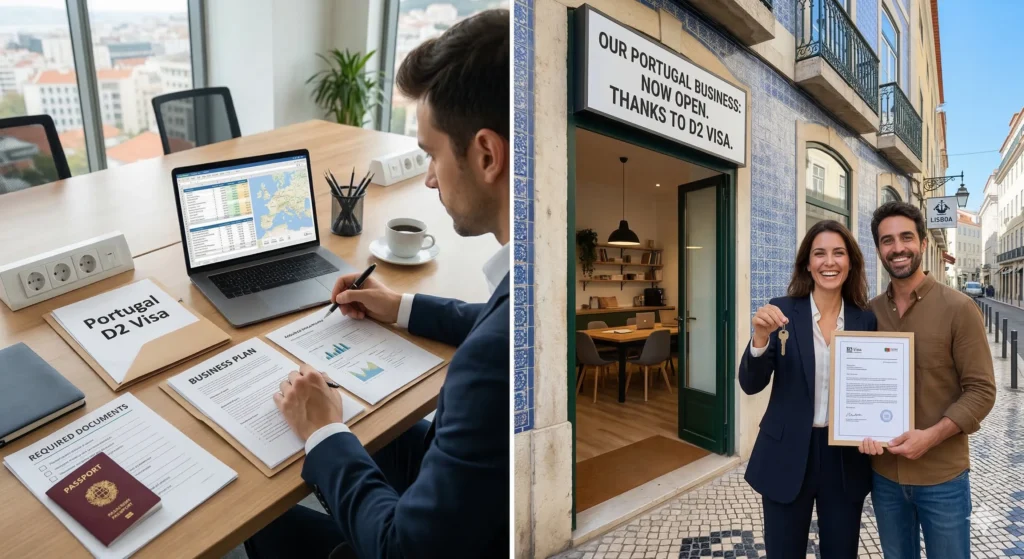
Second Visual: From Visa to Residence Card
The second image can help you imagine the steps after your visa is granted, from arrival in Portugal to getting your residence card and building your business.
Key Takeaways Table
| Area | Key Point |
|---|---|
| Visa type | For entrepreneurs and freelancers building real activity in Portugal |
| Investment | No fixed minimum, but realistic capital is important |
| Money to live | Show funds for living costs for you and your family for at least one year |
| Documents | Passport, crimes check, insurance, housing, NIF, bank account, business plan |
| Long‑term outcome | Possible permanent residence and citizenship if you meet all rules |
Suggested Video: Portugal D2 Visa Overview
You can watch this helpful YouTube video that walks through D2 visa basics, common mistakes and tips for a strong application:
Portugal D2 Visa for Entrepreneurs – Step by Step Guide
Search this title on YouTube or click the link above to find a recent, detailed guide.
Internal and External Resources
- Official information: Check the Portuguese consulate or embassy website in your country for the newest rules and forms.
- Private guides: Websites like immigration law firms and relocation services give updated D2 visa checklists and examples.
If you run a travel or immigration blog, you can link this article to internal pages about:
- Cost of living in Portugal
- Best cities in Portugal for expats
- Difference between D2, D7 and Startup visas
And you can link out to official consulate pages and Portuguese government portals for credibility.
Frequently Asked Questions (FAQ)
1. Is there a fixed minimum investment for the D2 visa?
No, there is no official fixed minimum investment in the law, but many experts suggest having realistic capital, often around or above 5,000 euros for company share capital plus enough money to live.
2. Do I need to create jobs in Portugal?
There is no strict rule that you must hire staff, but it helps if your plan shows that you may create jobs or bring other benefits, such as services, innovation or tax revenue.
3. How long does the D2 visa process take?
Timing varies by consulate, but many applications can take several weeks to a few months. It is smart to apply early and avoid last‑minute plans.
4. Can my family come with me?
Yes, your spouse and dependent children can usually join you under family reunification, as long as you show enough financial means and suitable housing.
5. Can I travel in Europe with a D2 residence card?
With a Portuguese residence permit, you can usually travel within the Schengen Area for short stays, but you must still follow each country’s entry rules.
6. Can I switch from another visa to D2 inside Portugal?
In some cases it is possible to change your status while in Portugal, but rules can change. It is best to check with AIMA or an immigration lawyer before you decide.
Final Tip
Always confirm the latest D2 visa rules with the Portuguese consulate in your country or with an experienced immigration lawyer, because requirements and amounts can change over time.
Related Articles
- Cayman Visa Requirements: Simple Step By Step Guide
- Qatar Airways Visa Requirements: Clear Guide For 2026 Travelers
- How To Migrate To Canada As An Agricultural Worker From Africa
Get visa, passport, and travel-planning guides like this one sent straight to your inbox — plus first access to new country guides and scholarship roundups.