
Converting a tourist visa to a work visa in the USA is possible, but it requires careful planning and the right employer support. This guide explains the process step by step, the rules you must follow, and the different work visa options available to you.
Key Takeaways
- Yes, you can change status from a B-1/B-2 tourist visa to a work visa while in the USA
- You need an employer sponsor to file a petition on your behalf before you can work
- The 90-day rule matters: changing status within 90 days of arrival may trigger fraud concerns
- You cannot work on a tourist visa while waiting for your work visa approval
- Common work visa options include H-1B (specialty workers), O-1 (extraordinary ability), and L-1 (company transfers)
- H-1B has an annual lottery with registration typically in March each year
Can You Really Change From a Tourist Visa to a Work Visa?
Yes, you can. U.S. immigration law allows people on B-1/B-2 tourist visas to apply for a change of status to certain work visa categories. This is called a “change of status” and it lets you stay in the country while your new visa is processed.
However, there are important rules you must follow:
- Your tourist visa must still be valid when you apply
- You must have entered the USA legally
- You must not have violated your visa terms (like working without permission)
- You need an employer willing to sponsor you
“You can’t begin working while you are still on a tourist visa! Some work visas like the H-1B, O-1, and L-1 require employer sponsorship. So the very first step for an H-1B visa is a U.S. employer willing to sponsor your visa application.”
The key point is this: you cannot switch to a work visa on your own. An employer must file a petition for you with U.S. Citizenship and Immigration Services (USCIS).
The 90-Day Rule and Why It Matters
The 90-day rule is a guideline USCIS uses to judge whether someone lied about their intentions when entering the country.
What Triggers the Rule
If you do any of the following within 90 days of arriving on a tourist visa, USCIS may assume you planned to do this all along:
- Apply for a change of status to a work visa
- Get married to a U.S. citizen
- Start working without authorization
Consequences of Violating the Rule
If USCIS believes you misrepresented your intentions, you could face:
- Denial of your change of status application
- Revocation of your current visa
- Potential bars from future immigration benefits
How to Avoid Problems
The safest approach is to wait more than 90 days before applying for a change of status. This removes the automatic presumption of fraud, though USCIS can still question your intentions.
If your situation genuinely changed after arriving (for example, you received an unexpected job offer), document everything carefully. An immigration lawyer can help you present your case properly.
Types of Work Visas You Can Switch To
Several work visa categories allow changes of status from a tourist visa. Each has different requirements.
H-1B Visa (Specialty Occupations)
The H-1B is the most common work visa for professionals in fields like technology, engineering, medicine, and finance.
Requirements:
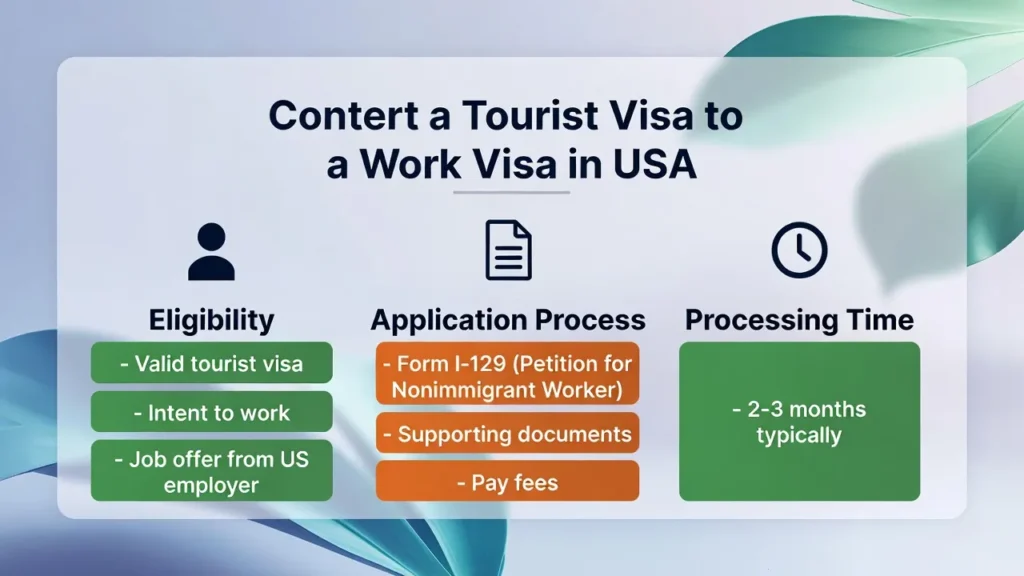
- Job must require at least a bachelor’s degree in a specific field
- You must have the required degree or equivalent work experience
- U.S. employer must sponsor you
- Subject to annual lottery (cap of 65,000 plus 20,000 for advanced degree holders)
H-1B Timeline for 2026:
| Stage | Timeframe |
|---|---|
| Employer registration | March 2026 |
| Lottery results announced | Late March 2026 |
| Petition filing window | April to June 2026 |
| Work start date (if approved) | October 1, 2026 |
The biggest challenge with H-1B is the lottery system. More people apply than visas available, so selection is random.
O-1 Visa (Extraordinary Ability)
The O-1 visa is for people with extraordinary ability in sciences, arts, education, business, or athletics.
Requirements:
- Proof of major awards (like a Nobel Prize or Olympic medal) OR
- Evidence of at least three achievements showing extraordinary ability
- Job offer from a U.S. employer
- No annual cap or lottery
Benefits:
- No annual limit on visas issued
- Initial stay of up to 3 years with unlimited extensions
- Can be processed faster than H-1B
L-1 Visa (Intracompany Transfers)
The L-1 is for employees transferring from a foreign office to a U.S. office of the same company.
Requirements:
- Must have worked for the company abroad for at least 1 year in the past 3 years
- Must be transferring as a manager, executive (L-1A), or specialized knowledge worker (L-1B)
- U.S. and foreign companies must have a qualifying relationship
Quick Comparison of Work Visas
Step-by-Step Process to Change Status
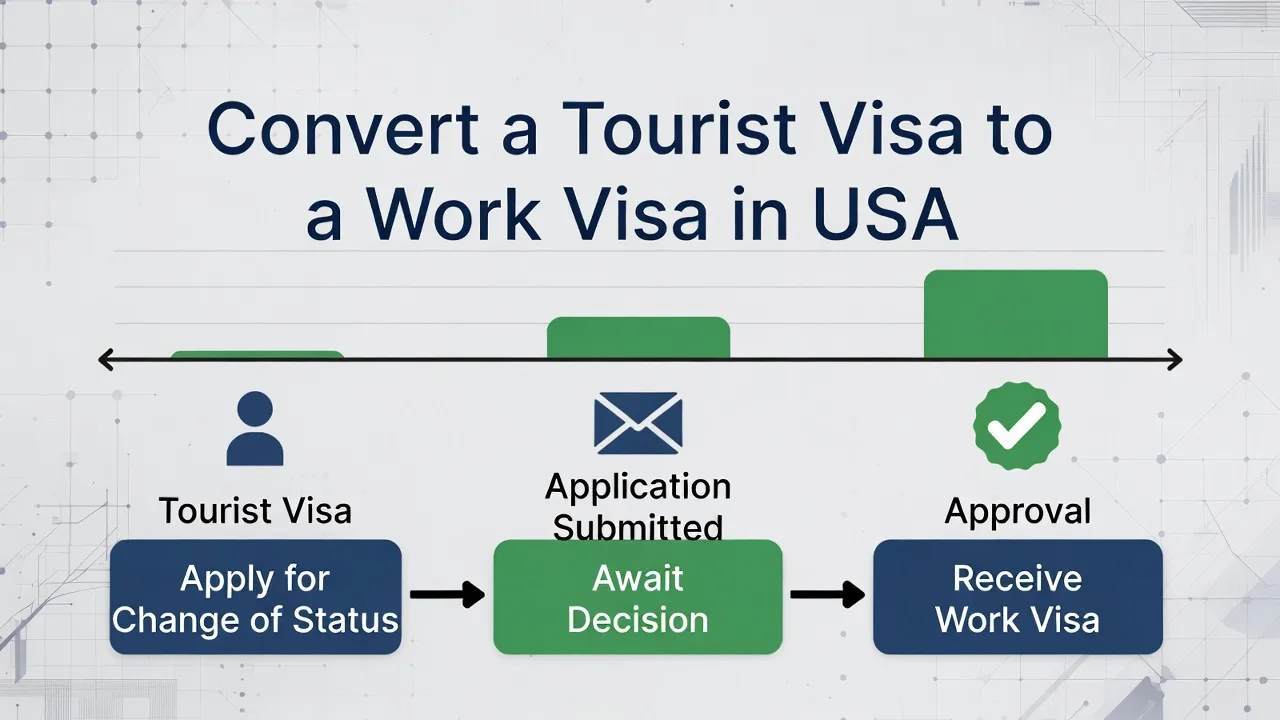
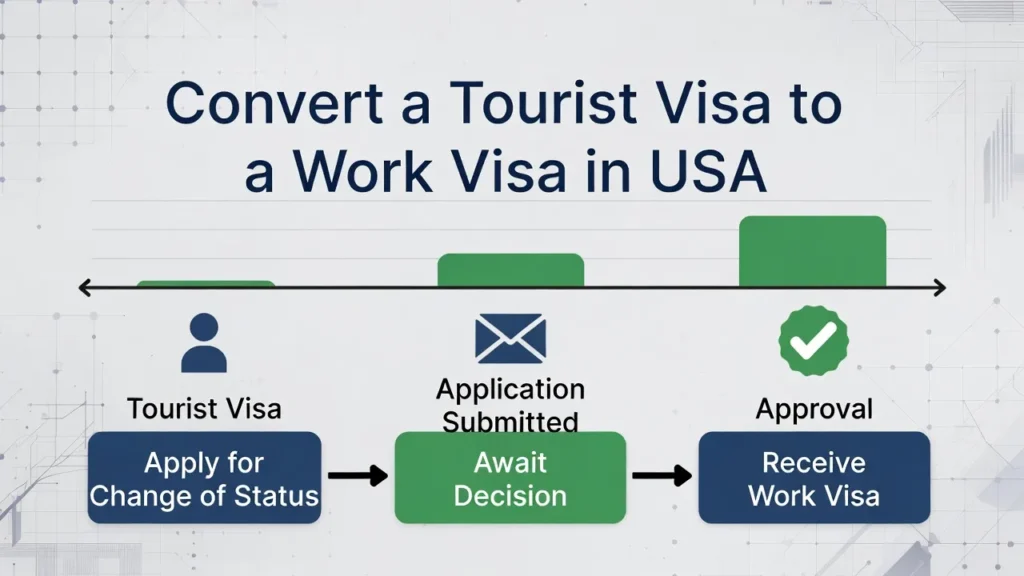
Here is how to change from a B-1/B-2 tourist visa to a work visa.
Step 1: Find an Employer Sponsor
You cannot apply for a work visa by yourself. A U.S. employer must agree to hire you and file a petition on your behalf.
Important: You cannot work while searching for a sponsor. Job hunting is allowed on a tourist visa, but actually working is not.
Step 2: Employer Files Form I-129
Your employer must submit Form I-129 (Petition for a Nonimmigrant Worker) to USCIS. This form tells USCIS about the job, your qualifications, and why the company needs you.
Documents typically required:
- Completed Form I-129
- Job offer letter with salary, duties, and employment period
- Your educational credentials and transcripts
- Your passport and current visa documents
- Labor Condition Application (LCA) for H-1B
- Evidence of your qualifications
Step 3: USCIS Processes the Petition
USCIS reviews the petition to make sure both you and the employer meet requirements. Processing times vary:
| Processing Type | Timeframe |
|---|---|
| Regular processing | 3 to 6 months |
| Premium processing (extra fee) | 15 business days |
For H-1B petitions, your employer must first be selected in the lottery before filing.
Step 4: Receive Approval
If USCIS approves your petition, you will receive a Form I-797 Approval Notice. This document shows your new status and when you can begin working.
For H-1B: Even if approved, you cannot start working until October 1 of that fiscal year.
Maintaining Status While Waiting
One of the biggest challenges is staying legal while your petition is processed.
Keep Your Tourist Visa Valid
Your B-1/B-2 status must remain valid while USCIS processes your change of status. If your tourist visa expires before approval, you may need to:
- Apply for an extension of your B-1/B-2 status
- Leave the country and return on your new work visa (consular processing)
Do Not Work Without Authorization
This is critical. Working on a tourist visa is illegal and will result in serious consequences:
- Your visa may be revoked immediately
- You may be deported
- You could be banned from reentering the USA
You must wait until your work visa is approved AND the authorized start date has arrived before you can legally work.
Alternative Path: Consular Processing
If you cannot maintain your tourist status long enough, you have another option: consular processing.
How It Works
- Your employer files Form I-129 with USCIS
- After approval, you leave the USA
- You schedule a visa interview at a U.S. embassy or consulate in your home country
- After getting your work visa stamped, you reenter the USA
When to Choose Consular Processing
Consular processing makes sense if:
- Your B-1/B-2 status will expire before your work visa is approved
- You have concerns about the 90-day rule
- You need to travel internationally anyway
Common Mistakes to Avoid
1. Working Before Approval
Never work before your change of status is approved and the start date has arrived. This is the most common and most serious mistake.
2. Applying Too Soon After Arrival
Applying for a change of status within 90 days of entering the USA raises red flags. Plan carefully and consult an immigration lawyer if needed.
3. Missing Deadlines
Keep track of all deadlines:
- Your I-94 expiration date
- H-1B lottery registration dates
- Petition filing windows
4. Not Having Backup Plans
The H-1B lottery is random. Many qualified people are not selected. Have alternative plans like O-1, L-1, or returning to your home country to apply from abroad.
Frequently Asked Questions
Can I work while my change of status is pending?
No. You cannot work on a tourist visa under any circumstances. You must wait until USCIS approves your work visa petition AND your authorized work start date arrives.
How long does the change of status process take?
Processing times vary by visa type and USCIS workload. Regular processing takes 3 to 6 months. Premium processing (available for some visa types) takes 15 business days but costs an additional fee.
What happens if my tourist visa expires before my work visa is approved?
You have two options: apply to extend your B-1/B-2 status while waiting, or leave the USA and complete the process through consular processing abroad.
Can I change from tourist visa to any type of work visa?
Most work visa categories allow changes of status, but each has specific requirements. You need to qualify for the visa type and have an employer willing to sponsor you.
Is the H-1B lottery guaranteed if I qualify?
No. The H-1B has an annual cap, and more people apply than visas available. Selection is random through a lottery system. Many qualified applicants are not selected each year.
What if I entered the USA planning to find a job and stay?
This could be considered visa fraud. Tourist visas are meant for temporary visits, not job hunting with intent to stay permanently. If your intentions genuinely changed after arriving due to an unexpected opportunity, document everything and consult an immigration lawyer.
Do I need a lawyer to change status?
While not legally required, an immigration lawyer can help you navigate the complex process, avoid mistakes, and present your case properly to USCIS.
Final Tips for Success
- Start early: Work visa processes take months, so begin planning well in advance
- Stay legal: Never overstay your visa or work without authorization
- Document everything: Keep records of your relationship history with the employer and when decisions were made
- Consider alternatives: If H-1B does not work out, explore O-1, L-1, or other visa categories
- Get professional help: Immigration law is complex, and mistakes can have serious consequences
Converting a tourist visa to a work visa is possible with the right employer support and careful planning. The process requires patience and attention to detail, but many people successfully make this transition every year.
Related Articles
- Work Abroad from Ghana: Real Visa Routes for 2026
- US Work Visa Guide for Chinese Professionals: H-1B, L-1, and EB-1A Pathways (2026)
- Work Visas Without a College Degree: Real Pathways for 2026
Official sources to check before you apply or travel
- U.S. Department of State – U.S. Visas
- GOV.UK foreign travel advice (entry requirements by country)
- Government of Canada travel advice and advisories
Visa rules, fees, processing times and entry requirements change often. Always confirm the current requirements on the official government website, or with the embassy or consulate, before you apply, pay or travel. One Visa Center is an independent information site, not a law firm or government agency, and this article is not legal advice. Read how we research, fact-check and use AI tools in our Editorial Policy.
Get visa, passport, and travel-planning guides like this one sent straight to your inbox — plus first access to new country guides and scholarship roundups.