Smart Traveler’s Guide: Securing Your 6 Month Travel Insurance
Embarking on an extended journey is an exciting prospect. Whether you are planning a gap year, a sabbatical, remote work from abroad, or an extensive backpacking adventure, a longer trip requires more than just careful packing and flight bookings. One of the most critical elements for any long-term traveler is robust travel insurance. For trips lasting half a year, standard short-term policies simply will not do. This is where specialized 6 month travel insurance becomes an absolute necessity.
Extended travel brings unique challenges and risks. From unexpected medical emergencies in a foreign country to lost luggage across continents, having the right coverage can transform a potential disaster into a manageable inconvenience. Understanding the nuances of a 6 month policy will not only protect your finances but also provide invaluable peace of mind, allowing you to fully immerse yourself in your adventure without constant worry.
This comprehensive guide will walk you through everything you need to know about 6 month travel insurance. We will cover what it is, why it is different, what it typically covers, how to choose the best policy for your needs, and common pitfalls to avoid. Prepare yourself with the knowledge to make informed decisions and ensure your extended travels are safe, secure, and truly unforgettable.
Key Takeaways
- Specialized Coverage is Crucial: Standard travel insurance often caps at 30 or 60 days, making dedicated 6 month policies essential for longer trips.
- Medical Care is Paramount: Ensure your policy offers substantial medical emergency coverage, including evacuation, as healthcare costs abroad can be astronomical.
- Understand Your Activities: If you plan on adventurous sports or work, verify your policy covers these specific activities to avoid claim denials.
- Compare Policy Details Carefully: Focus on limits, deductibles, exclusions, and customer service reviews, not just the premium price.
- Declare Pre-Existing Conditions: Always disclose any existing health issues to prevent your policy from being voided when you need it most.
Understanding 6 Month Travel Insurance: What Is It?
Six month travel insurance is a specific type of travel protection designed for individuals or families taking extended trips that last up to 180 days. Unlike annual multi-trip policies, which cover multiple shorter trips within a year, or single-trip policies, which typically cover vacations of up to a few weeks, a 6 month policy is tailored for one continuous, longer journey.
These policies are structured to provide comprehensive coverage for the entire duration of your half-year adventure. They recognize that longer trips inherently carry different risk profiles and require more robust protection than a typical two-week holiday. This includes everything from continuous medical coverage to protection against extended periods of travel disruption.
Beyond Standard Policies

Standard travel insurance often has limitations on trip length. Many basic policies will only cover trips up to 30 or 60 days. Exceeding this limit, even by a single day, can invalidate your entire policy. A 6 month policy, sometimes referred to as long-stay or extended-stay travel insurance, is specifically underwritten to cover these longer durations, providing peace of mind for the full 180 days.
This extended coverage usually comes with higher limits for medical expenses and personal liability, acknowledging the increased likelihood of needing assistance over a longer period. It also often includes benefits relevant to long-term travelers, such as options for emergency dental care or continuous access to a 24/7 assistance line, which can be invaluable when you are far from home.
Who Needs It Most?
Anyone planning to be outside their home country for approximately six months should consider this type of insurance. Common travelers who benefit include:
- Gap Year Students: Exploring the world before university or starting a career.
- Backpackers: Traversing multiple countries on a budget.
- Sabbatical Takers: Professionals taking a break for personal growth or travel.
- Digital Nomads: Working remotely while experiencing different cultures.
- Long-Term Volunteers: Participating in extended humanitarian or environmental projects.
- Expats in Transition: Those moving abroad but needing temporary coverage before settling.
What Does a 6 Month Policy Typically Cover?
While specific coverages vary between providers and policy tiers, a comprehensive 6 month travel insurance plan generally includes several key components. Understanding these will help you compare options effectively and ensure you are adequately protected for your extended journey.
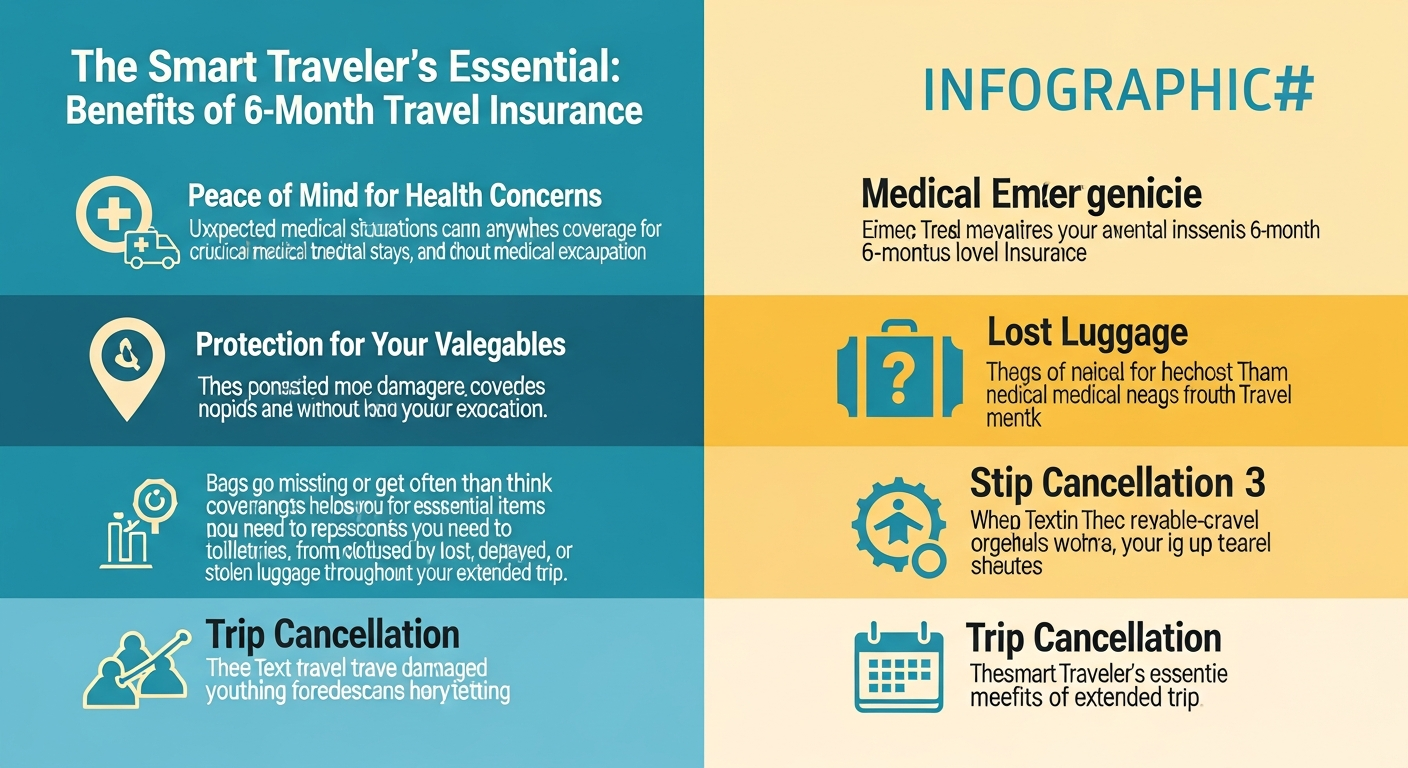
Medical Emergencies and Evacuation
This is arguably the most critical component of any travel insurance, especially for long trips. Medical emergencies can happen anywhere, and healthcare costs abroad can be staggering. A good policy will cover:
- Emergency Medical Treatment: Hospital stays, doctor visits, surgery, and prescription medications.
- Emergency Dental Treatment: For sudden pain or injury.
- Medical Evacuation: Transport to the nearest adequate medical facility, or even back to your home country if medically necessary.
- Repatriation of Remains: In the unfortunate event of death abroad.
Trip Cancellation and Interruption
Even with meticulous planning, unforeseen circumstances can derail your trip. This coverage protects your financial investment in your travel plans:
- Trip Cancellation: Reimburses non-refundable expenses (flights, accommodations, tours) if you must cancel your trip before departure due due to covered reasons like illness, injury, or a family emergency.
- Trip Interruption: Covers expenses if your trip is cut short after it has begun, including the cost of returning home early and lost prepaid trip costs.
Lost Luggage and Personal Belongings
Misplaced or stolen items are a common headache for travelers. This benefit helps mitigate the financial impact:
- Lost, Stolen, or Damaged Baggage: Reimbursement for the value of your belongings if they are lost, stolen, or damaged by an airline or other common carrier.
- Delay of Baggage: Coverage for essential items if your luggage is delayed for a certain period (e.g., 6-12 hours).
- Personal Effects: Coverage for other personal items like cameras, laptops, or passports if they are stolen or damaged.
Other Important Benefits
Many policies offer additional protections that enhance your travel security:
- Personal Liability: Covers legal expenses and compensation if you accidentally cause injury to someone or damage their property.
- Rental Car Excess Waiver: Sometimes an optional add-on, covering the deductible on your rental car insurance.
- Legal Assistance: Access to legal advice or representation if you encounter legal issues abroad.
- 24/7 Emergency Assistance: A crucial service that can help with everything from finding local medical care to replacing lost passports.
Choosing the Right 6 Month Travel Insurance: Key Factors
Selecting the best 6 month travel insurance policy requires careful consideration of several factors unique to your travel plans and personal situation. A one-size-fits-all approach rarely works for extended journeys.
Duration and Destinations
Confirm that the policy explicitly covers the full 180 days you plan to be away. Also, verify that all countries you intend to visit are included in the coverage. Some policies might exclude specific regions due to political instability, natural disaster risks, or high medical costs. If you are traveling to multiple continents, ensure your policy has worldwide coverage.
Age and Health Considerations
Your age can significantly impact premiums and available coverage. Older travelers might face higher costs or specific exclusions. Furthermore, it is absolutely essential to declare any pre-existing medical conditions when applying for insurance. Failing to do so can result in denied claims, even for unrelated incidents. Some policies offer waivers for pre-existing conditions, often at an additional cost, which is usually a worthwhile investment.
Activities and Adventures
If your 6 month trip involves adventurous activities like skiing, scuba diving, trekking, surfing, or even certain types of volunteer work, check if these are covered. Many standard policies exclude high-risk activities. You might need to purchase an adventure sports add-on or a specialized policy to ensure you are protected while pursuing your passions abroad.
Policy Limits and Deductibles
Carefully review the maximum payout limits for each coverage type (e.g., medical, baggage). For extended trips, higher limits are generally advisable. Also, understand the deductible (or excess) – the amount you must pay out-of-pocket before your insurance kicks in. A higher deductible usually means a lower premium, but it also means more personal expense if you need to make a claim.
Comparing Policies: What to Look For
When faced with multiple insurance options, a structured comparison can help you make an informed decision. Do not just look at the price; delve into the details.
| Feature | Standard Short-Term Policy | 6 Month Long-Stay Policy |
| **Maximum Trip Duration** | Typically 30-60 days | Up to 180 days (or more, depending on policy) |
| **Medical Coverage Limits** | Moderate (e.g., $50,000 – $100,000) | High (e.g., $250,000 – $1,000,000+) |
| **Emergency Evacuation** | Basic coverage | Comprehensive, often including repatriation |
| **Pre-Existing Conditions** | Often excluded or limited without add-on | More options for coverage, often with waivers |
| **Adventure Activities** | Usually excluded, requires add-on | May include basic adventure, or offer extensive add-ons |
| **Personal Liability** | Lower limits | Higher limits, more robust protection |
| **Customer Support** | Standard business hours or basic 24/7 | Robust 24/7 global assistance, multi-lingual support |
| **Cost (Relative)** | Lower upfront premium | Higher upfront premium, but better value for duration |
Read Reviews and Check Financial Strength
Before committing, research the insurance provider’s reputation. Look for customer reviews regarding their claims process, responsiveness, and overall service. Also, check the financial strength ratings of the insurer. A financially stable company is more likely to honor its commitments when you need them most.
“The true value of travel insurance isn’t just in its price, but in the peace of mind it offers when you are thousands of miles from home. For extended trips, skimping on coverage is a gamble you cannot afford to lose.” – *Expert Travel Advisor*
Common Pitfalls to Avoid When Buying 6 Month Travel Insurance
Even seasoned travelers can make mistakes when purchasing insurance. Being aware of these common pitfalls can save you significant trouble and expense down the line.
Underinsurance
Opting for the cheapest policy without thoroughly reviewing its limits can leave you severely underinsured. Imagine a medical emergency costing hundreds of thousands of dollars, only for your policy to cover a fraction of it. Always ensure your medical coverage is robust enough for your destinations, especially countries with high healthcare costs like the USA.
Ignoring Pre-Existing Conditions
This is a major reason for denied claims. If you have any medical conditions, no matter how minor you perceive them to be, you must declare them. Even conditions like asthma or high blood pressure need to be disclosed. Failure to do so can void your entire policy, meaning no coverage for any claim, even if it is unrelated to your pre-existing condition.
Not Reading the Fine Print
The policy wording contains all the exclusions, limitations, and specific conditions. Pay close attention to:
Exclusions: What the policy does not* cover (e.g., pandemics, acts of war, certain high-risk sports).
Last-Minute Purchases
While you can often buy travel insurance close to your departure date, purchasing it early is always recommended. Coverage for trip cancellation often begins from the date you buy the policy, not your departure date. This means if you buy early and an unforeseen event forces you to cancel before your trip even starts, you are already protected.
Making a Claim: A Step-by-Step Guide
Understanding the claims process before you need it can significantly reduce stress and improve your chances of a successful claim. Keep your policy details accessible throughout your trip.
Before You Travel
- Print and Save Policy Documents: Keep physical and digital copies of your policy number, emergency contact details, and a summary of coverage.
- Know Your Policy: Understand what is covered, what is excluded, and your deductibles.
- Note Emergency Numbers: Have the insurer’s 24/7 emergency assistance number saved in your phone and written down.
During Your Trip
- Contact Insurer Immediately: For medical emergencies or significant incidents, contact your insurer’s emergency assistance line as soon as reasonably possible. They can guide you on local medical facilities and procedures.
- Gather Evidence: Collect all relevant documentation. For medical claims, this means doctor’s notes, hospital bills, and prescription receipts. For lost or stolen items, get police reports (within 24 hours), property irregularity reports from airlines, and receipts for replacements.
- Keep Records: Maintain a detailed log of events, including dates, times, locations, and names of people you spoke with.
After Your Trip
- Submit Claim Promptly: Most policies have a time limit for submitting claims after an incident or your return home.
- Provide All Documentation: Submit all evidence you collected. The more thorough your documentation, the smoother the process.
- Be Patient and Persistent: Claims can sometimes take time to process. Follow up respectfully if you do not hear back within a reasonable timeframe.
Conclusion
Embarking on a 6 month adventure is a profound experience that promises memories for a lifetime. However, such an extensive journey also comes with inherent risks that demand robust protection. Six month travel insurance is not merely an optional extra; it is a fundamental pillar of responsible and worry-free long-term travel. By understanding its comprehensive benefits, carefully comparing policies, and avoiding common pitfalls, you equip yourself with the security needed to navigate any unexpected twists and turns your global exploration might bring.
Investing in the right 6 month travel insurance policy is an investment in your health, your finances, and your peace of mind. Do not let the excitement of planning overshadow the importance of protection. Take the time to research, choose wisely, and then embark on your adventure with confidence, knowing you are covered every step of the way.
Frequently Asked Questions (FAQ)
Q1: Is 6 month travel insurance mandatory?
While not always legally mandatory for entry into every country, 6 month travel insurance is highly recommended. Many countries, especially those in the Schengen Area, require proof of travel insurance for visa applications, and some may deny entry without adequate coverage. More importantly, it is crucial for your financial protection against unforeseen medical emergencies or other travel disruptions.
Q2: Can I extend a standard travel insurance policy to cover 6 months?
Generally, no. Most standard single-trip travel insurance policies have a maximum trip duration, often 30, 60, or 90 days. Attempting to extend them beyond their limits is usually not possible and can invalidate your coverage. It is always best to purchase a dedicated long-stay or 6 month policy from the outset for extended trips.
Q3: What happens if I return home early from my 6 month trip?
If you return home early, some insurance providers may offer a partial refund for the unused portion of your policy, especially if you have not made any claims. However, this is not guaranteed and depends on the specific terms and conditions of your policy. Always check with your insurer about their early return policy before purchasing.
Q4: Does 6 month travel insurance cover me for working abroad?
It depends on the type of work. Most standard travel insurance policies, including 6 month ones, do not cover paid employment, especially manual labor or hazardous jobs. If you plan to work abroad, you will likely need a specialized policy (e.g., working holiday insurance) or a separate local health insurance plan in your destination country. Always disclose your work intentions to your insurer.
Q5: Is there an age limit for 6 month travel insurance?
While there isn’t a universal age limit, older travelers (e.g., over 65 or 70) may find fewer options, higher premiums, and more exclusions for 6 month travel insurance. Some insurers specialize in policies for seniors, but it is essential to compare these carefully and ensure any pre-existing medical conditions are adequately covered.