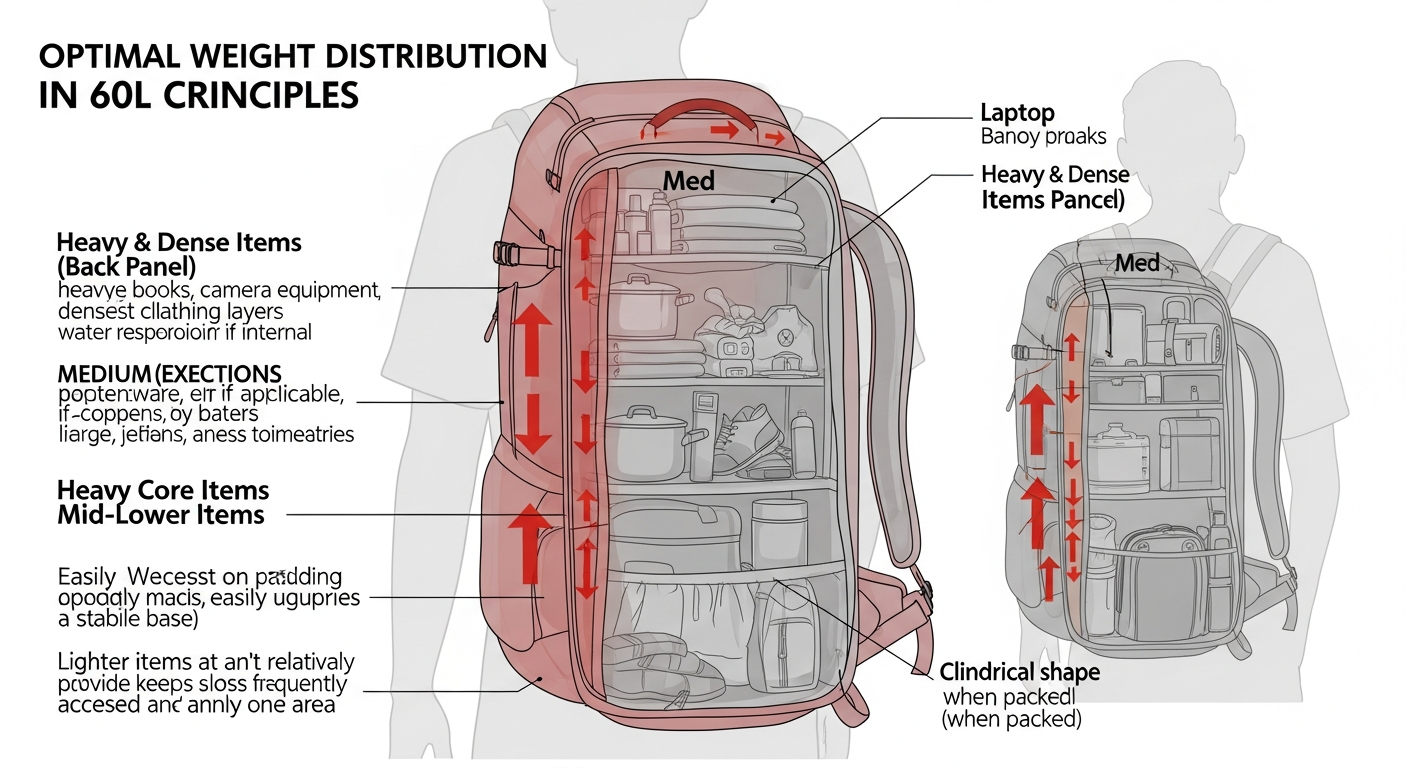

A 60-liter travel backpack is the sweet spot for trips of one to three weeks — big enough for real packing freedom, small enough to carry through a train station without regret. If you pack light or travel in warm climates, a 55L does the same job with less temptation to overpack; if you’re hauling camping gear or cold-weather layers, 65L earns its bulk. This guide covers the whole 55–65L range: what these packs actually hold, the features that separate great packs from shelf filler, honest airline rules (spoiler: none of these fly as carry-on), and how to choose between backpack, duffel, and wheeled formats.
Key Takeaways
- 60L ≈ 1–3 weeks of clothing with packing cubes and a laundry stop; 55L suits minimalists, 65L suits gear-heavy trips.
- All 55–65L packs are checked luggage. Standard carry-on allowances top out around 40–45L (roughly 55 × 40 × 23 cm) — no compression trick changes that.
- Fit beats features. A correctly sized hip belt carries about 80% of the load; measure your torso length before you shop.
- Front-loading (panel) access beats top-loading for travel — you unzip it like a suitcase instead of excavating.
- Watch loaded weight. A fully packed 60L can brush against typical 23 kg (50 lb) checked-bag limits.
What a 60L Backpack Actually Holds
Think of 60 liters as: 7–10 clothing changes in packing cubes, a second pair of shoes, toiletries, a packable jacket, and a daypack lashed to the outside — with room to bring souvenirs home. On the capacity spectrum, 35–45L is the carry-on zone, 50–65L is the “checked bag with backpack freedom” zone, and 70L+ is expedition territory that punishes you at every staircase.
55L vs 60L vs 65L: Which Size Fits Your Travel?
| Size | Best for | Trip length | Watch out for |
|---|---|---|---|
| 55L | Minimalists, warm-climate trips, travelers who launder weekly | 1–2 weeks | Still a checked bag on nearly all airlines — don’t buy it expecting carry-on savings |
| 60L | The versatile middle: city-hopping, mixed climates, long backpacking routes | 1–3 weeks | Easy to overpack to the weight limit; use cubes with discipline |
| 65L | Cold-weather travel, camping gear, family “shared space” packing | 2 weeks+ | Heavy when full; check the pack’s empty weight — over ~2.5 kg compounds fast |
The Features That Actually Matter
1. Suspension and fit — comfort is king
The hip belt should sit on your iliac crest and carry roughly 80% of the weight; shoulder straps only stabilize. Look for an adjustable or multi-size torso system, load-lifter straps, and a ventilated back panel. Measure your torso (C7 vertebra to iliac crest) — packs are sized to torso length, not your height.
2. Access — front-loading wins for travel
Top-loading packs come from mountaineering, where you rarely unpack mid-day. For travel, a full front (panel) zip that opens like a suitcase saves you daily excavation. The best travel packs add a separate bottom compartment for shoes or laundry and a lockable laptop sleeve near the back panel.
3. Materials and build
Look for high-denier ripstop nylon (400D+ in wear zones), reinforced bottom panels, bar-tacked stress points, and large self-repairing coil zippers — zipper failure is the most common death of a travel pack. A rain cover (included or bought separately) matters more than fabric coatings in a real downpour.
4. Organization and security
Internal compression straps keep loads from shifting; stretch side pockets hold bottles; a hip-belt pocket keeps your phone reachable. For security: lockable zipper pulls, slash-resistant placement of valuables against your back, and a low-profile look that doesn’t advertise expensive gear.
Backpack vs. Duffel vs. Wheeled at 60L
- Travel backpack: best on stairs, cobblestones, buses, and multi-stop routes. The default choice for backpacking trips.
- Duffel (or duffel-backpack hybrid): best for gear hauling and one-destination trips; hybrids with stowable straps split the difference.
- Wheeled: best for smooth-floor itineraries (airports, hotels) and travelers protecting their back — at the cost of ~2 kg of frame and terrible cobblestone manners.
Proven Pack Families to Start Your Search
Rather than chase specs that change every model year, start with the lines that have earned decade-long reputations, then verify current specs and prices with the maker: Osprey Farpoint / Fairview (the travel-specific benchmark, panel-loading), Osprey Atmos / Aura AG 65 (trekking comfort), Gregory Baltoro / Deva 65 (load-hauling suspension), and Deuter Aircontact (ventilated carry). Fit varies by body — try loaded packs in person where possible.
Airline Reality Check
Every pack in this size class travels as checked luggage: typical checked allowances are 23 kg (50 lb) and around 158 cm total linear dimensions, which a 55–65L pack fits easily — but the weight adds up faster than you think. Protect straps from conveyor damage by clipping the hip belt backwards around the pack or using a transit cover. Before you fly, confirm your airline’s current baggage rules, and make sure your travel documents and passport validity (the 6-month rule) are sorted — a perfect pack doesn’t help at a closed check-in desk.
Packing a 60L Like You’ve Done It Before
- Cubes for categories — tops, bottoms, underlayers; compression cubes for bulky items.
- Heavy items against your spine, centered between shoulder blades — the pack carries dramatically better.
- Leave 10–15% empty on departure day; you will acquire things.
- One “airport access” pocket: documents, chargers, layers — never buried.
- Consider travel insurance that covers baggage if your gear is worth protecting.
Frequently Asked Questions
Is a 60L backpack too big for carry-on?
Yes — on virtually every airline. Carry-on limits generally cap out around 40–45L (about 55 × 40 × 23 cm). A 55L, 60L, or 65L pack should be planned as checked luggage from the start.
Should I choose 55L or 60L?
Choose 55L if you pack light, do laundry weekly, and travel mostly warm climates. Choose 60L if you want margin for cooler layers, souvenirs, or longer stretches between laundry. The empty weights are usually similar — the risk of 60L is simply packing more than you need.
How heavy is a loaded 60L backpack?
Typically 12–18 kg depending on gear. Keep it under 20% of your body weight for comfortable all-day carry, and remember typical 23 kg airline checked limits.
Backpack or wheeled bag for Europe?
Multi-city European trips with trains, metro stairs, and cobblestones favor a backpack. Single-city trips on smooth surfaces favor wheels. Duffel-backpack hybrids are the honest compromise.
What torso length do I need?
Measure from your C7 vertebra (the bump at the base of your neck) to the top of your iliac crest (hip bones). Most brands map that measurement to XS–L sizes or offer adjustable systems — fit to torso, not height.
