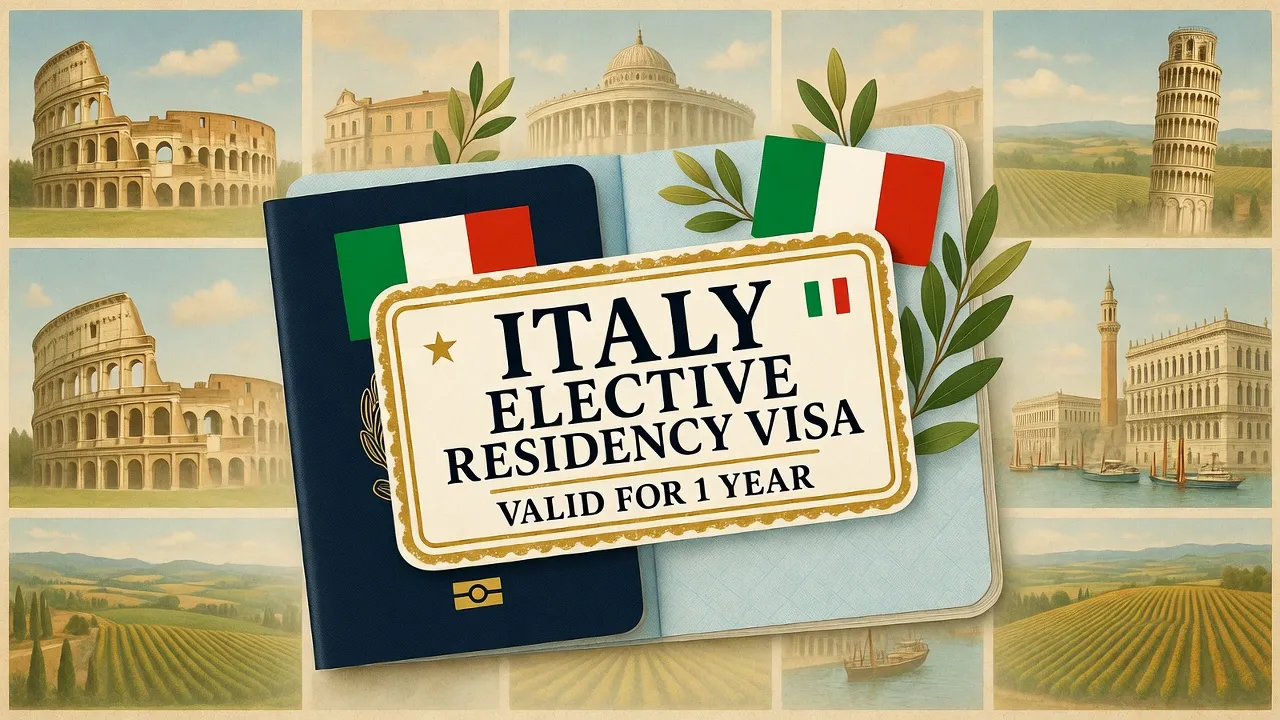

Want to live in Italy without working? The Italy Elective Residency Visa (ERV) is your path to la dolce vita. This visa lets you live in Italy long term if you can prove you have enough passive income to support yourself.
The minimum income requirement is EUR 31,000 per year for a single person, rising to EUR 38,000 for couples. Unlike work visas, this visa does not allow any employment in Italy. Your income must come from pensions, investments, rental properties, or other passive sources.
Key Takeaways
- Minimum income of EUR 31,000 per year for single applicants, EUR 38,000 for couples.
- You cannot work in Italy on this visa (no employment or self‑employment of any kind).
- You must secure housing in Italy before applying (purchase or one‑year registered lease).
- Private health insurance valid for at least one year is mandatory.
- Consulate processing time is up to 90 days.
- Initial residence permit is valid for 1 year, renewable annually.
- After 5 years, you can apply for permanent residency.
- After 10 years, you can apply for Italian citizenship.
Who Is the Elective Residency Visa For?
The ERV is designed for people who want to live in Italy without working. This includes:
- Retirees with pension income
- Investors living off dividends and interest
- Property owners with rental income
- Wealthy individuals with substantial passive income
- Anyone with stable passive income who dreams of living in Italy
Important: This visa is NOT for digital nomads or remote workers. Even working remotely for a foreign company is not permitted on this visa. If you want to work remotely, you should look into Italy’s Digital Nomad Visa instead.
Financial Requirements Explained
The income requirements are the most critical part of your application.
Minimum Income by Applicant Type
| Applicant Type | Minimum Annual Income |
|---|---|
| Single person | EUR 31,000–32,000 |
| Married couple | EUR 38,000 |
| Each dependent | Additional 5% to 20% |
Note: Some consulates require higher amounts. In particular, some US consulates may ask for EUR 50,000–60,000+ depending on your income sources. Always check with your specific consulate.
Acceptable Income Sources
Your income must be passive and ongoing. The following sources typically qualify:
- Public or private pensions
- Social Security benefits
- Real estate rental income
- Dividends from investments
- Interest from savings and bonds
- Trusts and annuities
- Income from business ownership (without active work)
Income Sources That Do NOT Qualify
- Salary from employment
- Self‑employment income
- Remote work income
- Freelance earnings
- One‑time savings or lump sums without recurring income
Example: A US retiree receiving about EUR 2,600 per month (around USD 2,800) in Social Security benefits meets the single‑person requirement of roughly EUR 31,000 per year.
Required Documents Checklist
You must gather these documents before applying.
Personal Documents
- Long‑term visa application form (Type D)
- Valid passport with at least one blank page
- Passport‑size photo (3.5cm x 4.5cm, white background)
- Copy of passport biodata page
Financial Documents
- Bank statements from the last 3–6 months
- Proof of ongoing passive income sources
- Pension statements (if applicable)
- Tax returns showing income
- Investment account statements
- Rental agreements if you earn rental income
Housing Documents
- Deed of ownership for property in Italy, OR
- One‑year rental contract registered with Agenzia delle Entrate
Hotel or short‑term bookings are NOT accepted.
Insurance Documents
- Private health insurance valid for at least one year
- Coverage must include medical care, hospitalization, and emergencies
- Policy must be valid in Italy and throughout the Schengen area
Background Check
- FBI background check (for US citizens) or equivalent national check
- Criminal record certificate, translated into Italian and legalized/apostilled
Step‑by‑Step Application Process
Step 1: Secure Housing in Italy
Before you can apply, you must already have a place to live in Italy. This means:
- Purchasing a property (with notarial deed), OR
- Signing a one‑year lease registered with the Italian tax office
Because you must commit to housing before knowing if your visa will be approved, many people negotiate a rental contract with a clause allowing cancellation if the visa is denied.
Step 2: Gather All Documents
- Collect all items from the checklist.
- Translate foreign documents into Italian using a certified translator.
- Get apostilles or legalizations where required.
- Ensure bank statements are recent (usually within the last 30 days).
Step 3: Schedule Consulate Appointment
- Contact the Italian consulate that has jurisdiction over your place of residence.
- Appointment wait times vary widely (often 2 to 8 months).
Step 4: Attend Your Appointment
Appear in person at the consulate with all original documents and copies. Be prepared to explain:
- Your income sources and amounts
- Why you want to live in Italy
- Your accommodation arrangements
- Any ties you have to Italy (family, property, visits, etc.)
Step 5: Wait for Processing
- The consulate typically has up to 90 days to review your application.
- They may request additional documents, perform background checks, or call you for a follow‑up interview.
Step 6: Receive Your Visa
- If approved, you will receive a Type D long‑stay visa stamped in your passport.
- The visa is usually valid for entry into Italy within 365 days.
Step 7: Arrive in Italy and Register
Within 8 working days of arriving in Italy, you must:
- Apply for your Permesso di Soggiorno (residence permit) at the post office/Questura.
- Register your residence at the local Anagrafe (civil registry).
Processing Time and Costs
| Item | Details |
|---|---|
| Consulate processing | Up to 90 days |
| Visa fee | Around EUR 116 |
| Initial permit validity | 1 year |
| Appointment waits | Typically 2–8 months |
Living in Italy on the ERV
Residency Requirements
To keep your status, you must actually live in Italy, which generally means:
- Spending more than 183 days per year in Italy.
- Maintaining your registered address in Italy.
- Having utility bills and other proof that you truly reside there.
Extended absences may cause problems when renewing your permit.
Renewing Your Permit
Your initial residence permit is valid for one year. To renew, you must show:
- Continued passive income at or above the required threshold.
- Ongoing residence and housing in Italy.
- Valid private health insurance (or proof of enrollment in the Italian system).
- Clean immigration and criminal record.
Path to Long‑Term Residency
After 5 years of continuous legal residence in Italy with valid permits, you can apply for the EU long‑term residence permit, which gives more stable rights.
Path to Italian Citizenship
After 10 years of continuous residence in Italy, you may apply for Italian citizenship by naturalization, subject to language and integration requirements.
Tax Benefits for Retirees and High‑Net‑Worth Individuals
Italy offers special tax regimes that can pair well with the ERV:
- 7% Flat Tax for Foreign Pensioners: Eligible foreign retirees who move to specific municipalities (mainly in Southern Italy and some special zones) can pay only 7% tax on their foreign income for up to 10 years.
- EUR 200,000 Flat Tax: High‑net‑worth individuals can elect to pay a flat EUR 200,000 per year on foreign income, plus EUR 25,000 per additional family member, for up to 15 years.
Consult a tax professional to see if these regimes apply to you.
Best Places to Retire in Italy
Popular regions for ERV holders include:
- Tuscany – Rolling hills, vineyards, and historic towns like Siena and Lucca; more affordable outside Florence.
- Umbria – “Green heart of Italy” with hill towns like Orvieto and Perugia and a quieter, authentic feel.
- Le Marche – Adriatic coastline, charming villages, and low costs of living; some areas qualify for tax incentives.
- Sicily – Stunning landscapes, rich history, and some of the lowest prices in Italy; cities like Palermo and Catania offer full services.
- Abruzzo – Mountains and beaches combined, plus very affordable housing and living costs.
Frequently Asked Questions
What is the minimum income for the Italy Elective Residency Visa?The minimum income is generally around EUR 31,000 per year for a single applicant and about EUR 38,000 for a couple, with an additional percentage for each dependent. Some consulates demand higher amounts.
Can I work on an Elective Residency Visa?No. You cannot work in Italy on this visa, including remote work for foreign companies or self‑employment. Your income must be fully passive.
How long does the ERV take to process?Once your application is submitted, the consulate can take up to 90 days to decide. However, getting an initial appointment can add another 2–8 months.
Do I need to own property in Italy?No. You do not have to own property, but you must secure accommodation (owned or rented) before applying. A one‑year registered rental contract is acceptable; hotel bookings are not.
Can my spouse and children come with me?Yes. Spouses, registered partners, and dependent children can be included, each with their own application. The income requirement increases accordingly.
Is health insurance required?Yes. You must have private health insurance valid for at least one year and covering medical care, hospitalization, and emergencies in Italy and the Schengen area. After moving, you may opt into Italy’s national health system (SSN) if eligible.
Related Articles
- Cayman Visa Requirements: Simple Step By Step Guide
- Qatar Airways Visa Requirements: Clear Guide For 2026 Travelers
- How To Migrate To Canada As An Agricultural Worker From Africa
Get visa, passport, and travel-planning guides like this one sent straight to your inbox — plus first access to new country guides and scholarship roundups.