
The P visa is a temporary work visa that allows internationally recognized athletes, entertainers, and cultural performers to work in the United States. Unlike the H-1B lottery system, P visas have no annual cap and are available year round to qualified applicants.
What is a P Visa?
The P visa category is designed for individuals coming to the US temporarily to perform as athletes, artists, or entertainers at a recognized level of achievement. This visa supports competitions, performances, tours, and cultural exchange programs without the restrictions found in other work visa categories.
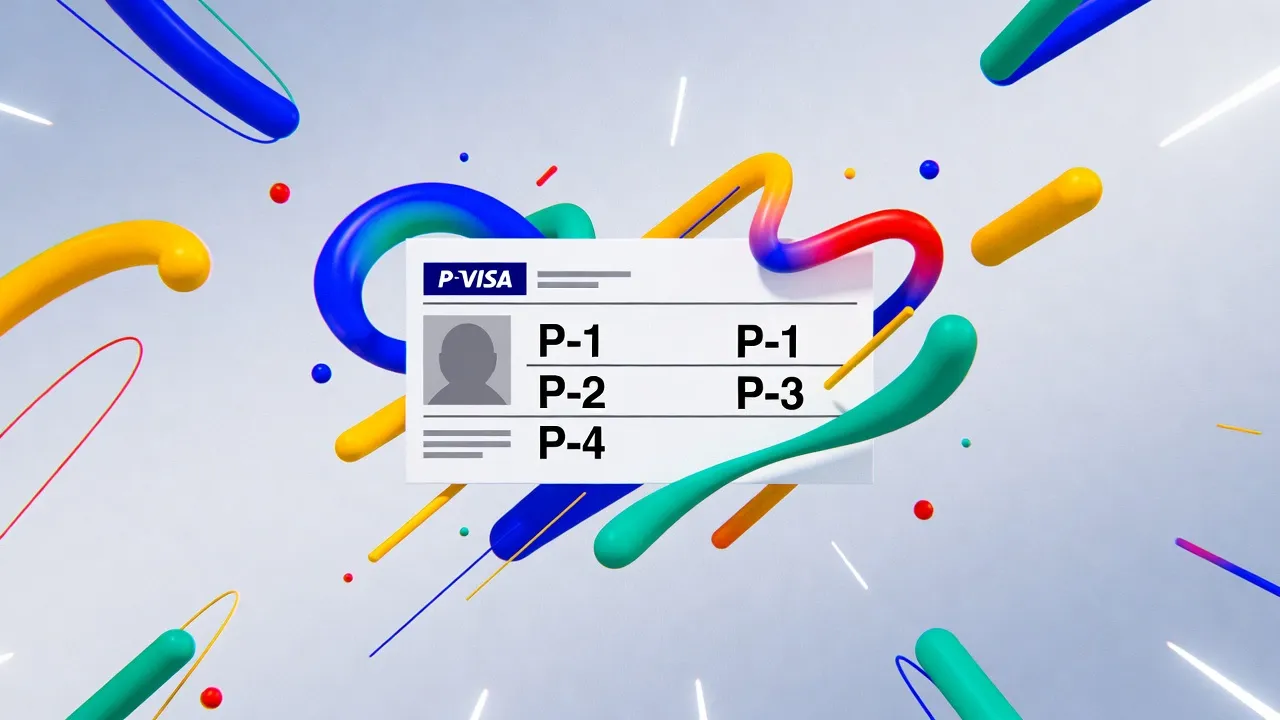
There are four main P visa types:
- P-1A: Internationally recognized individual athletes or athletic teams
- P-1B: Internationally recognized entertainment groups
- P-2: Artists or entertainers in reciprocal exchange programs
- P-3: Artists or entertainers in culturally unique programs
- P-4: Dependents (spouses and children under 21) of P-1, P-2, or P-3 holders
Important: Individuals cannot apply for P visas themselves. A US employer, agent, or sponsor must file the petition on their behalf with USCIS.
P-1A Visa for Athletes
The P-1A visa serves individual athletes and athletic teams competing at an internationally recognized level.
Who Qualifies for P-1A
To qualify for a P-1A visa, athletes must demonstrate:
- International recognition as an outstanding athlete
- A contract with a major US sports league or team
- OR a contract for an international sporting event of distinguished reputation
Evidence Requirements for Athletes
You must submit at least two of the following documents:
Examples of supporting evidence include participation in the Olympics, Pan American Games, European Championships, or competitions against national teams.
P-1A Duration of Stay
| Applicant Type | Initial Stay | Maximum Extensions | Total Limit |
|---|---|---|---|
| Individual athlete | Up to 5 years | 5 year increments | 10 years total |
| Athletic team | Up to 1 year | 1 year increments | No express limit |
P-1B Visa for Entertainment Groups
The P-1B visa covers entertainment groups that have achieved international recognition for sustained excellence.
Who Qualifies for P-1B
To be eligible, the entertainment group must:
- Be internationally recognized as outstanding in their discipline
- Have been established for at least 1 year
- Each member must have been an essential and integral part of the group for at least 1 year
Note: Individual entertainers do not qualify for P-1B visas. Solo performers must apply for an O-1B visa instead.
P-1B Evidence Requirements
Entertainment groups need to provide:
- Evidence of past performances and exhibitions
- Critical acclaim or significant recognition in their field
- Awards, publications, or testimonials from industry experts
- News articles or industry rankings
- Proof of the group’s sustained existence for at least one year
P-1B Duration of Stay
Entertainment groups receive an initial stay of up to 1 year, with extensions available in 1 year increments to complete performances.
P-2 Visa for Reciprocal Exchange Programs
The P-2 visa allows artists and entertainers to participate in reciprocal exchange programs between US and foreign organizations.
P-2 Requirements
To qualify for a P-2 visa:
- A labor organization must have arranged the exchange
- The US individual or group being exchanged must have comparable skills
- Terms of employment must be similar for both parties
The petition must be filed by the labor organization that arranged the exchange, a sponsor, or a US employer.
P-3 Visa for Culturally Unique Programs
The P-3 visa serves artists and entertainers who come to the US to perform, teach, or coach in a culturally unique program.
What Qualifies as Culturally Unique
Programs must involve:
- Traditional folk, cultural, or ethnic performances
- Musical, artistic, or theatrical programs
- Activities that foster understanding of the art form
- Development, interpretation, or representation of a unique cultural tradition
P-3 Requirements
Both individuals and groups can qualify for P-3 visas, unlike the group only P-1B category.
P-4 Visa for Dependents
Spouses and unmarried children under age 21 of P-1, P-2, or P-3 visa holders can accompany them to the US on a P-4 dependent visa.
P-4 Rules
- Dependents receive the same validity period as the principal visa holder
- P-4 holders cannot accept employment in the US
- Applicants must submit proof of relationship (marriage or birth certificates)
- Parents, in-laws, and adult children (21 or older) do not qualify
Essential Support Personnel
Highly skilled persons who provide support services to P visa holders may also qualify for P status.
Who Qualifies as Essential Support
Support personnel must:
- Perform services essential to the successful performance of the P visa holder
- Have skills that cannot be readily performed by a US worker
- Have appropriate qualifications for the services
- Possess critical knowledge of the specific services to be performed
Examples include coaches, trainers, scouts, team officials, referees, sound engineers, lighting technicians, and stage managers.
Support Personnel Documentation
Labor Consultation Requirement
A unique feature of P visas is the labor organization consultation requirement.
How the Consultation Works
- Petitioners must obtain an advisory opinion from an appropriate labor union
- The consultation must come from the national headquarters of a union with relevant expertise
- Unions typically respond with a letter of no objection
- Different activities may require consultations from different unions
The consultation requirement is waived for purely administrative positions like executive directors and business administrators.
Warning: USCIS now accepts negative consultation letters directly from labor unions to verify that petitioners have not falsified the consultation.
Application Process and Fees
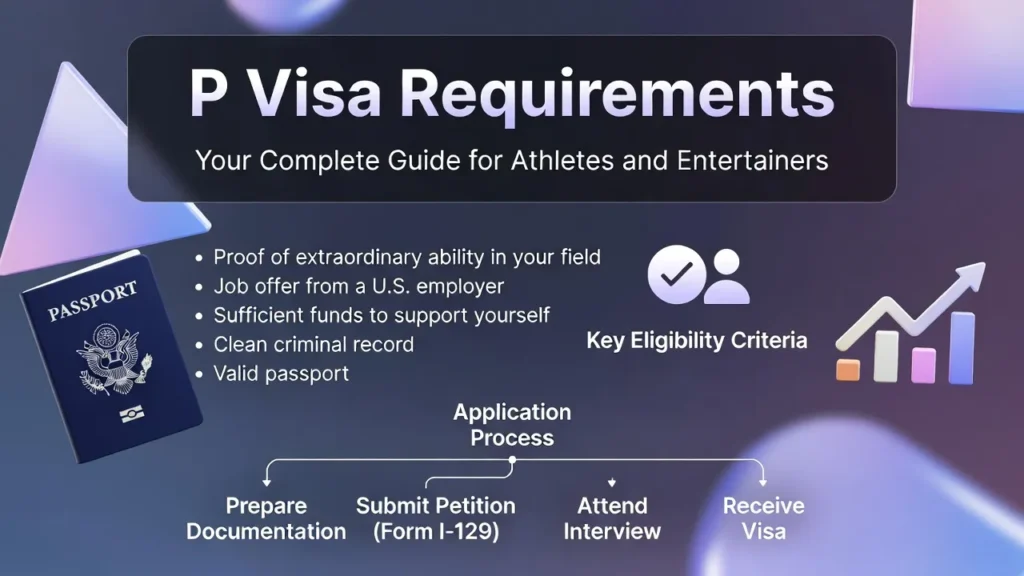
All P visa petitions must be filed using Form I-129 (Petition for Nonimmigrant Worker) with USCIS.
Required Documents
- Completed Form I-129 with O/P supplement
- Written contract between the group and US employer
- Detailed itinerary of events with dates and locations
- Evidence of beneficiary qualifications
- Labor organization consultation letter
- Petitioner qualifications (business license, tax returns)
Filing Fees
| Fee Type | Amount |
|---|---|
| Form I-129 base filing fee | Varies by category |
| Premium processing (optional) | $2,965 effective March 1, 2026 |
| DS-160 visa application | Paid at the consulate |
Premium processing guarantees a response within 15 business days.
Processing Timeline
Standard processing times vary depending on USCIS workload. Premium processing provides a guaranteed 15 business day timeline for an additional fee.
Applying at the US Consulate
After USCIS approves the petition, the applicant must apply for the actual visa at a US embassy or consulate.
Consulate Requirements
Extending Your P Visa
P visa holders can request extensions to complete events or continue activities.
Extension Rules
- File Form I-129 at least 45 days before your current status expires
- Extensions are granted in increments based on visa type
- P-1 individual athletes can extend up to the 10 year maximum
- Other P categories can extend in 1 year increments
P visa holders may stay an additional 10 days before and after the valid visa period for travel purposes.
Frequently Asked Questions
Can I apply for a P visa myself?
No, you cannot self petition for a P visa. A US employer, agent, sponsor, or in some cases a foreign employer through a US agent must file the petition on your behalf with USCIS.
What is the difference between P-1A and P-1B visas?
P-1A is for individual athletes and athletic teams, while P-1B is for entertainment groups. Individual athletes can apply for P-1A, but individual entertainers cannot apply for P-1B and must use the O-1B visa instead.
How long can I stay in the US on a P visa?
Individual athletes can stay up to 5 years initially with extensions up to 10 years total. Entertainment groups and other P categories typically receive 1 year stays with possible extensions.
Can my family come with me on a P visa?
Yes, your spouse and unmarried children under 21 can accompany you on P-4 dependent visas. However, they cannot work in the US while on P-4 status.
Do I need a labor consultation for my P visa?
Yes, most P visa petitions require an advisory opinion from an appropriate labor organization. The requirement is waived for purely administrative positions or when no appropriate union exists.
Can I change employers while on a P visa?
A new employer would need to file a new P visa petition on your behalf. The new petition must be approved before you can begin working for the new employer.
Key Takeaways
- P visas have no annual cap unlike the H-1B lottery system
- Employer must file the petition with USCIS on behalf of the applicant
- P-1A for individual athletes and teams; P-1B for entertainment groups only
- P-2 requires a reciprocal exchange program arranged by a labor organization
- P-3 covers culturally unique artistic and cultural programs
- One year minimum group membership required for P-1B entertainment groups
- Labor consultation required from an appropriate union for most petitions
- Individual athletes can stay up to 10 years total with extensions
- Premium processing costs $2,965 as of March 1, 2026 for a 15 day response
- P-4 dependents cannot work but can study in the US
Related Articles
- What are the requirements for Turkish passport
- US Visa Interview in Ghana: Accra Embassy Guide 2026
- EB-3 Visa for Nurses: Schedule A Green Card Guide 2026
Official sources to check before you apply or travel
- GOV.UK foreign travel advice (entry requirements by country)
- Government of Canada travel advice and advisories
Visa rules, fees, processing times and entry requirements change often. Always confirm the current requirements on the official government website, or with the embassy or consulate, before you apply, pay or travel. One Visa Center is an independent information site, not a law firm or government agency, and this article is not legal advice. Read how we research, fact-check and use AI tools in our Editorial Policy.
Get visa, passport, and travel-planning guides like this one sent straight to your inbox — plus first access to new country guides and scholarship roundups.