
Big news for early retirees: the Philippines has lowered the minimum SRRV age from 50 to 40 as of September 1, 2025, while keeping processing relatively fast and costs predictable. The Special Resident Retiree’s Visa (SRRV) allows indefinite residence, flexible multiple entry, and significant tax advantages on foreign pensions.
Key SRRV Highlights for 2026
- Minimum age: 40 years old from September 1, 2025 (down from 50).
- Visa deposit: USD 1,500–50,000, depending on age, category, and pension status.
- Processing time: about 10 working days once complete documents are filed with PRA.
- Application fee: USD 1,500 for the principal applicant; USD 300 per dependent.
- Immigration perks: indefinite stay, multiple entry, no exit clearances or annual BI report for SRRV holders.
- Tax perks: foreign pensions and foreign‑source income are generally exempt from Philippine income tax; deposit interest may also receive preferential treatment.
SRRV Categories and Who They Fit
The Philippine Retirement Authority (PRA) offers several SRRV “tracks” aimed at different retiree profiles.
| SRRV Category | Who It’s For | Key Features |
|---|---|---|
| SRRV Classic | Foreign nationals 40+ | Core retirement option; deposit can fund real estate or long lease. |
| SRRV Smile | Foreign nationals 50+ | Non‑convertible deposit; simple, low‑maintenance option. |
| SRRV Courtesy | Former Filipinos (often 35/40+ depending on rule) | Strongly discounted deposits for Philippine‑born retirees abroad. |
| SRRV Expanded Courtesy | Retired military, diplomats, certain gov’t personnel | Preferential deposit levels and terms. |
Local guidance now explicitly recognizes 40–49 as an eligible band under updated Classic and Courtesy options.
Updated Deposit Requirements
Official PRA schedules and 2025–2026 guidance show the new deposit brackets by age and pension status.
Ages 40–49 (Newly Eligible Band)
| Category | With Pension | Without Pension |
|---|---|---|
| SRRV Classic | USD 25,000 | USD 50,000 |
| SRRV Courtesy (Former Filipino) | ~USD 3,000 (typical) | ~USD 3,000–6,000 depending on track |
| SRRV Expanded Courtesy | USD 3,000 | USD 6,000 |
Ages 50 and Above
| Category | With Pension | Without Pension |
|---|---|---|
| SRRV Classic | USD 15,000 | USD 30,000 |
| SRRV Smile | N/A | USD 20,000 (non‑convertible) |
| SRRV Courtesy (Former Filipino) | USD 1,500 | USD 1,500 |
| SRRV Expanded Courtesy | Around USD 1,500–3,000 | Around USD 1,500–3,000 |
PRA’s revised processing guide confirms: Classic pensioner deposits are now USD 25,000 (40–49) and USD 15,000 (50+), while non‑pensioner Classic deposits are USD 50,000 (40–49) and **USD 30,000 (50+).
Pension Requirements for Reduced Deposits
To qualify for the lower deposit tier, you must show a lifetime pension.
Typical minimums used by PRA and specialist firms:
- Single applicant: about USD 800/month.
- With dependents (spouse/children): about USD 1,000/month or more.
Accepted pension sources usually include:
- State pensions (e.g., US Social Security, UK State Pension).
- Employer / private retirement plans.
- Military or civil service retirement pay.
- Lifetime disability pensions.
The key test is that benefits are lifelong, not a temporary annuity.
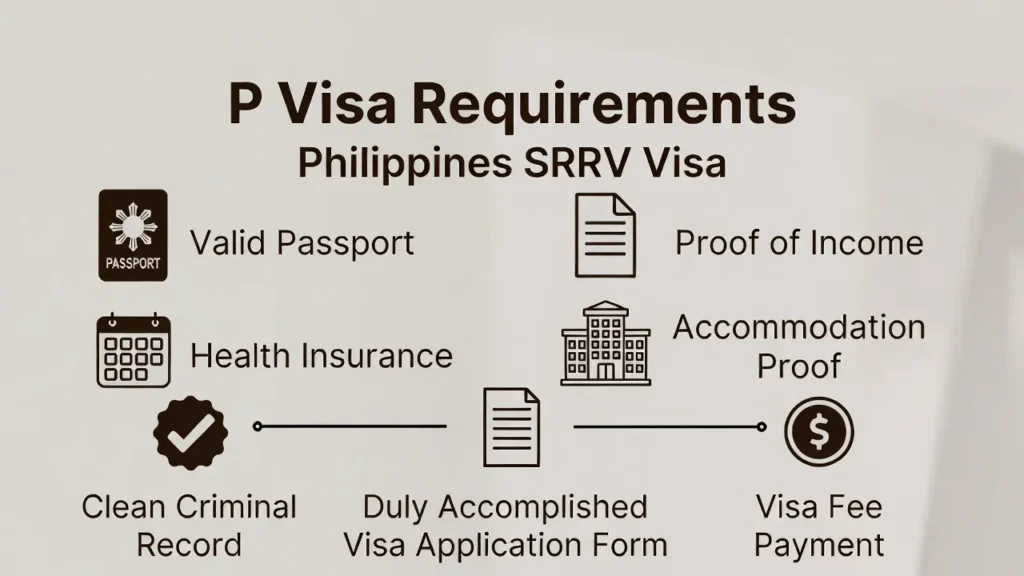
Required Documents: Practical Checklist
SRRV applications are document‑heavy; getting these right saves weeks.
Core personal documents
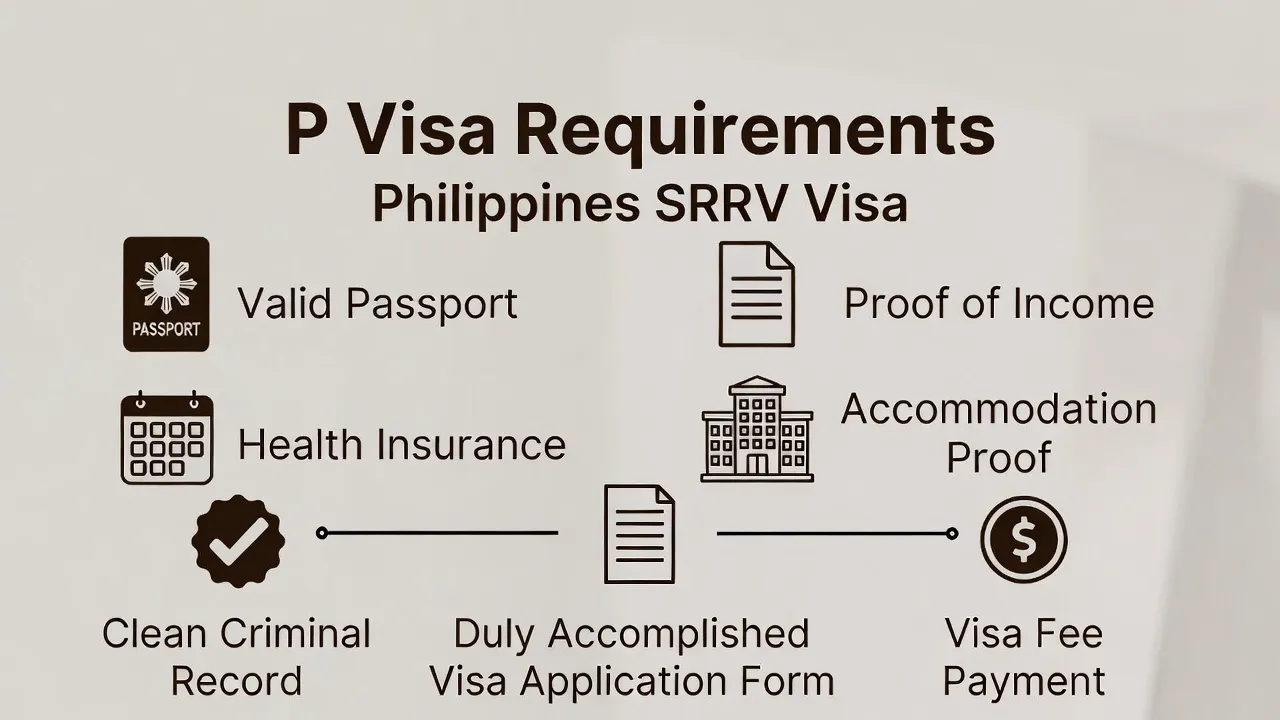
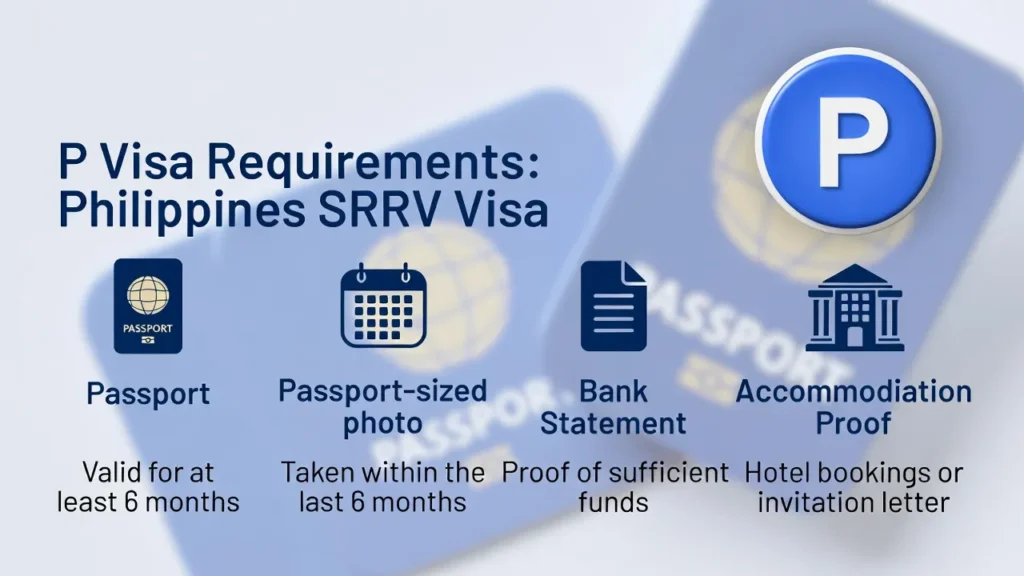
- PRA SRRV application form, signed.
- Valid passport (with valid Philippine entry status, usually a tourist stay upon arrival).
- Multiple passport photos in PRA‑specified sizes.
Medical & police clearances
- Medical certificate on the official PRA form from a licensed or PRA‑accredited clinic in the Philippines.
- Police clearance from your home country, authenticated/apostilled.
- Philippine NBI Clearance if you have stayed in the Philippines for more than 90 days before filing.
Financial documents
- Bank certificate from a PRA‑accredited bank confirming the SRRV deposit.
- Proof of foreign pension (if using pension track), apostilled and showing monthly entitlement.
- SWIFT remittance slip / inward‑remittance certification proving funds came from a foreign bank account in your name (local transfers and cash are not accepted for the main deposit).
Category‑specific
- Former Filipinos: PSA birth certificate or old Philippine passport.
- Military/diplomatic applicants: Certificates from the relevant agency plus pension evidence.
Application Process: Step‑by‑Step
Timing varies by how quickly you can assemble documents, but the PRA’s own flow is clear.
- Prepare documents abroad
- Get home‑country police clearance and pension proof, then apostille/authenticate and translate to English if needed.
- Enter the Philippines on a valid stay (often tourist)
- Many applicants enter visa‑free or on a tourist visa; those on other visa types may need to “downgrade” to tourist status before PRA filing.
- Complete Philippine‑side requirements
- Medical exam on PRA form at an accredited clinic.
- NBI Clearance (if >90 days in the country).
- Any required Bureau of Immigration clearances.
- Transfer the SRRV deposit
- Wire the required deposit from a foreign bank to a PRA‑accredited bank (e.g., Development Bank of the Philippines or authorized private banks) and secure the bank certificate + inward remittance proof.
- File with PRA
- Submit the application at PRA’s head office (Makati) or a satellite office.
- Pay: USD 1,500 principal fee; USD 300 per spouse/dependent; plus the initial annual PRA fee (USD 50–360 depending on SRRV type).
- PRA evaluation and BI endorsement
- PRA review and BI coordination usually take around 10 working days for the core PRA step; full end‑to‑end timeline is often 6–10 weeks including document prep and BI stamping.
- Approval & Oath‑taking
- Attend a brief oath at PRA.
- Receive: SRRV stamp in your passport, PRA ID card, and SRRV certificate.
SRRV Benefits and Tax Treatment
SRRV is attractive because it serves as a long‑term residence permit with recurring, not one‑off, benefits.
Immigration benefits
- Indefinite residence in the Philippines as long as you keep the SRRV in good standing.
- Multiple‑entry privileges without repeated tourist visas.
- No exit clearance, re‑entry permits, or annual “alien registration” at BI for SRRV holders (PRA handles your status).
Tax and customs benefits
- Foreign‑source pensions and many foreign‑source incomes are not subject to Philippine income tax under current rules if structured properly.
- One‑time duty‑free import of used household goods up to a capped value (around USD 7,000 equivalent in many guides).
- Interest on the SRRV time deposit may enjoy favorable treatment depending on bank and regulations.
Other perks
- Ability to convert the Classic deposit into qualifying property or a long lease, subject to PRA rules.
- Access to PRA support, member services, and coordination with government agencies.
- Dependents (spouse and eligible children) can be attached to your SRRV and receive their own IDs.
For long‑term planning, many expats treat SRRV as a quasi‑permanent residency; after around 10 years of continuous residence, some choose to explore naturalization routes, though citizenship is a separate legal process with its own criteria.
Popular SRRV Retirement Destinations
SRRV retirees tend to cluster in cities that balance hospitals, infrastructure, and lifestyle.
- Cebu City – Big‑city amenities, tertiary hospitals, an international airport, malls, and beach/island access.
- Dumaguete – Known as a “university town” with laid‑back coastal life, low costs, and a strong expat scene.
- Davao City – Clean, orderly, and security‑focused, with good healthcare and lower crime rates.
- Tagaytay – Cool climate near Manila with lake and volcano views, popular among older retirees sensitive to tropical heat.
- Bohol (esp. Panglao) – Growing airport and expat base, with nature, beaches, and quieter island living.
FAQ
What is the new minimum age for SRRV?As of September 1, 2025, the minimum age is 40 years old, greatly expanding eligibility beyond the previous 50+ rule.
How much deposit do I need?Between USD 1,500 and USD 50,000, depending on age, category, and whether you have a qualifying lifetime pension; the most common figures are USD 25,000–50,000 (age 40–49) and USD 15,000–30,000 (age 50+).
How long does processing really take?PRA’s core processing is roughly 10 working days, but including document prep and BI stamping, most applicants should plan for 6–10 weeks total.
Is my foreign pension taxed in the Philippines?Foreign pensions are generally exempt from Philippine income tax when received by SRRV retirees under current tax provisions, though Philippine‑source income remains taxable.
Can I bring my spouse and kids?Yes. Spouse and qualifying dependent children can be included; each dependent adds a USD 300 application fee, and pension minimums increase slightly if you claim the reduced‑deposit option.
Is the deposit refundable?Yes. The SRRV deposit remains in your name and is normally refundable if you cancel your SRRV and settle any obligations, minus bank and minor administrative charges
Related Articles
- EB-2 NIW Requirements: The 2026 Self-Petition Guide
- EB-2 vs EB-3 Visa: Key Differences & Downgrade Strategy
- Essential Diplomatic Missions for Global Travel and Visa Services (A-E) with Addresses
Official sources to check before you apply or travel
- GOV.UK foreign travel advice (entry requirements by country)
- Government of Canada travel advice and advisories
Visa rules, fees, processing times and entry requirements change often. Always confirm the current requirements on the official government website, or with the embassy or consulate, before you apply, pay or travel. One Visa Center is an independent information site, not a law firm or government agency, and this article is not legal advice. Read how we research, fact-check and use AI tools in our Editorial Policy.
Get visa, passport, and travel-planning guides like this one sent straight to your inbox — plus first access to new country guides and scholarship roundups.