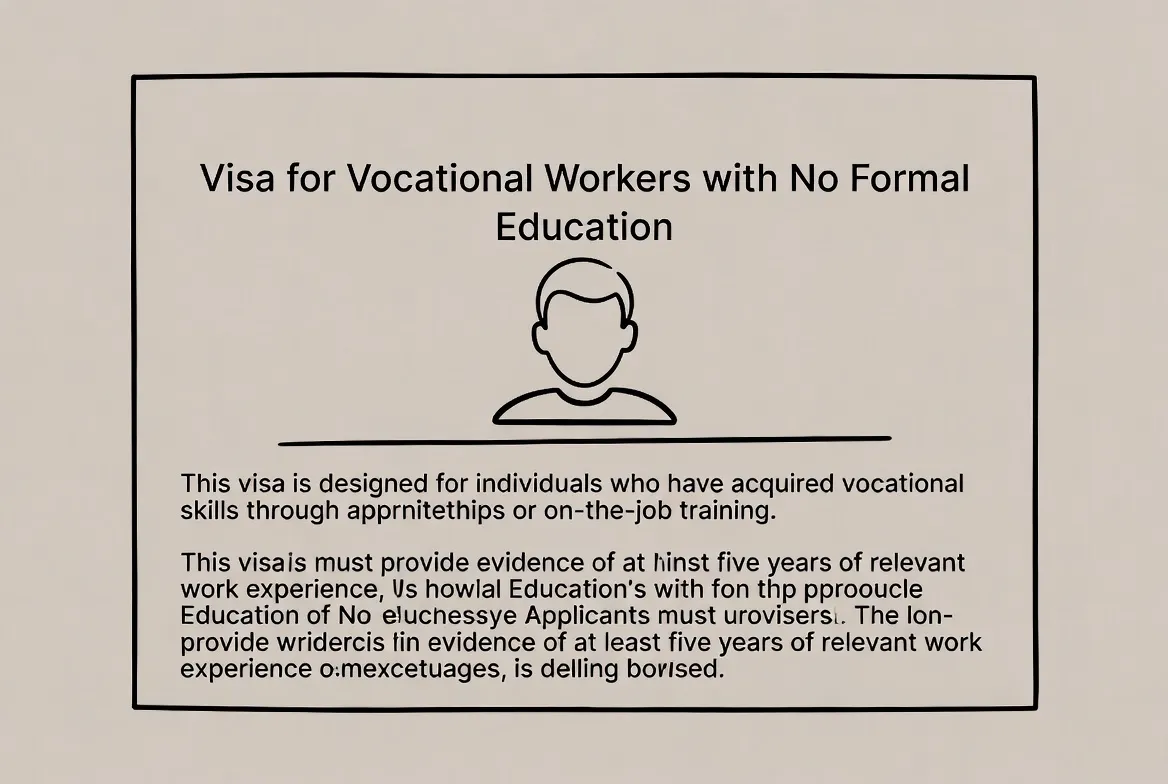

For many skilled workers globally, extensive practical experience, rather than formal education, defines their career. The challenge for these individuals is finding a legal pathway to work in the United States, as many popular employment visas, such as the H-1B, require a bachelor’s degree.1
Fortunately, there is a specific non-immigrant visa designed for temporary employment in jobs that often rely on practical skill over academic certification.2 This article will focus on the H-2B Temporary Non-Agricultural Worker Visa as the primary solution for individuals with strong vocational skills but no basic education seeking temporary US employment.
The Visa Solution: The H-2B Temporary Worker Visa
The H-2B Visa is a non-immigrant visa that allows US employers to bring foreign nationals to the United States to fill temporary non-agricultural jobs.3 This is the critical distinction that makes it suitable for skilled trades and vocational workers without a high school diploma or equivalent.
The focus of the H-2B is on the temporary need of the employer and the worker’s ability to perform the job, not their academic history.
Key Visa Type: H-2B Temporary Non-Agricultural Worker Visa
Suitable Vocations:
The H-2B visa is commonly used in industries such as:
- Construction: Specialized framers, roofers, dry-wall installers, or masonry workers.4
- Hospitality/Tourism: Cooks, resort staff, and specialty cleaners.5
- Landscaping: Grounds maintenance, irrigation specialists, or tree trimmers.
- Seafood Processing and other temporary manufacturing.6
Requirements for the H-2B Visa Pathway
The entire H-2B immigration process is employer-driven, meaning the individual cannot apply without a job offer.7 The burden of proof rests primarily on the US company (the petitioner).8
1. The Temporary Job Offer
- The job must be non-agricultural (agricultural jobs use the H-2A visa).9
- The work must be temporary, seasonal, intermittent, or due to a peak load.10 The need cannot be permanent.
- The duration is typically up to one year, with potential extensions up to a maximum stay of three years.11
2. Employer Requirements (Labor Certification)
The US employer must first prove to the Department of Labor (DOL) that:
- There are not enough US workers who are able, willing, qualified, and available to do the temporary work.12
- Hiring the foreign worker will not adversely affect the wages and working conditions of similarly employed US workers.13
- The employer must file and receive a Temporary Labor Certification from the DOL.14
3. Worker Requirements (Focus on Vocational Skill)
While the H-2B visa does not impose a minimum education requirement, the worker must still:
- Be a national of a country designated by the Department of Homeland Security (DHS) as eligible for the program.15
- Have a valid job offer in writing.
- Meet the minimum qualifications required for the specific position, which means providing strong proof of vocational experience (letters from former employers, portfolios, testimonials, or specialized certifications).16
- Demonstrate nonimmigrant intent (intent to return to their home country upon the visa’s expiration).17
Step-by-Step Process for Securing H-2B Employment
The process for obtaining the H-2B visa is a collaboration between the US employer and the foreign worker.18
| Phase | Description | Key Action |
| Step 1: Job Search | Worker seeks out US employers known to hire H-2B temporary workers or that openly advertise US visa sponsorship. | Secure a definitive written job offer in a skilled trade. |
| Step 2: DOL Certification | The employer files the Temporary Labor Certification with the DOL to prove the need and the lack of US workers. | Worker prepares documentation of their years of vocational experience for the employer to use as evidence. |
| Step 3: USCIS Petition | Once the DOL approves the labor certification, the employer files Form I-129 (Petition for a Nonimmigrant Worker) with the USCIS. | Worker awaits the USCIS approval, evidenced by Form I-797 (Notice of Action) sent to the employer. |
| Step 4: Visa Application | The worker applies for the H-2B visa at a US Embassy or Consulate in their home country. | Complete Form DS-160 (Online Nonimmigrant Visa Application) and schedule the consular interview. |
| Step 5: Consular Interview | The final stage, where the Consular Officer verifies the worker’s intent and qualifications. | Present the approved Form I-797 and evidence of ties to the home country (nonimmigrant intent). |
This specialized temporary work visa offers a critical avenue for experienced individuals whose credentials lie in practical skill, not academic degrees.
- H-2B Visa: The specific visa type for temporary, non-agricultural employment.19
- No Basic Education Requirement: Highlighted advantage for this visa category.
- Vocational Skills: The core qualification required for the job.
- Temporary Work Visa: Defines the non-immigrant nature of the stay.20
- US Visa Sponsorship: The necessity of securing an employer to initiate the process.
- Skilled Trades: The type of job roles typically filled (e.g., construction, hospitality, landscaping).21
- USCIS/DOL: The government bodies involved in the petition process.
Successfully navigating the H-2B immigration route allows experienced, non-degreed skilled tradesmen the chance to legally work and travel in the USA, contributing their vocational expertise to US industries with temporary labor shortages.
Related Articles
- Could Higher US H-1B Visa Fees Push Tech Workers to Canada?
- Ghana Visa & Travel Hub: The Complete 2026 Guide
- August 2026 Visa Bulletin: EB-1 to EB-4 Dates Explained
Official sources to check before you apply or travel
- GOV.UK foreign travel advice (entry requirements by country)
- Government of Canada travel advice and advisories
Visa rules, fees, processing times and entry requirements change often. Always confirm the current requirements on the official government website, or with the embassy or consulate, before you apply, pay or travel. One Visa Center is an independent information site, not a law firm or government agency, and this article is not legal advice. Read how we research, fact-check and use AI tools in our Editorial Policy.
Get visa, passport, and travel-planning guides like this one sent straight to your inbox — plus first access to new country guides and scholarship roundups.