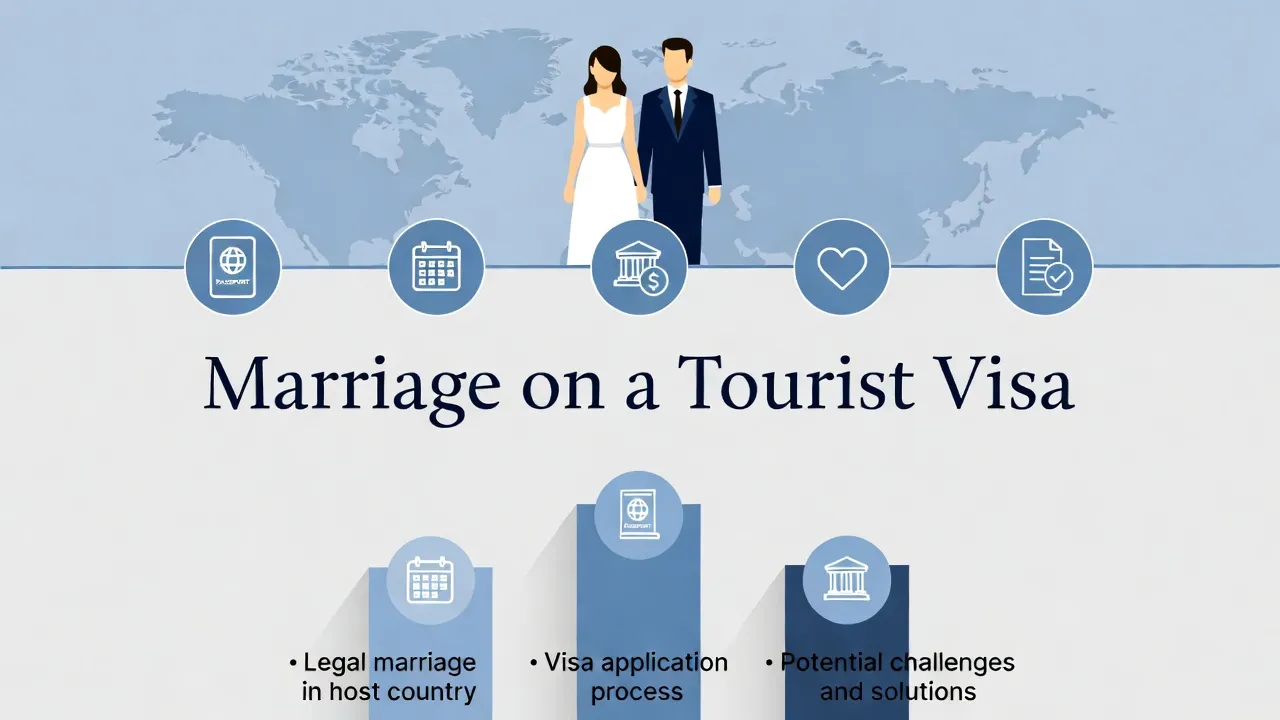

Getting married is one of the most exciting moments in life. If you are visiting the United States on a tourist visa (B-1/B-2) or the Visa Waiver Program (ESTA) and you fall in love, you might wonder: “Can I get married here legally?”
The short answer is yes. You are allowed to get married in the U.S. while on a tourist visa. However, what happens after the wedding is where things get tricky.
This guide will explain everything you need to know in simple terms. We will cover the rules, the risks, and the correct steps to take so you do not get into trouble with immigration.
Key Takeaways
- Legality: You can get married on a tourist visa.
- The Trap: You cannot enter the U.S. with the preconceived intent to stay and adjust your status.
- The 90-Day Rule: Avoid marrying or filing paperwork within the first 90 days of your entry.
- Best Path: The safest option is to marry in the U.S., return home, and apply for a spouse visa (Consular Processing).
- Documentation: Keep proof of your relationship (photos, messages) to prove your love is real.
1. Is It Legal to Marry on a Tourist Visa?
Yes, it is 100% legal for two people to get married in the United States, even if one person is a tourist.
The marriage license—the piece of paper that says you are married—is a state document, not an immigration document. The clerk at the marriage office does not usually care about your visa status. They just want to know if you are single and old enough to marry.
However, there is a big catch.
While getting married is fine, using a tourist visa to move to the U.S. permanently is not.
Important Note: A tourist visa is for visiting. It is not for living in the U.S. If you enter the U.S. with a tourist visa but you secretly plan to get married and stay forever, that is called visa fraud.
Always be honest about your travel plans.
2. The Golden Rule: “Intent” Matters
To understand the rules, you must understand one word: Intent.
When you entered the United States, the border officer probably asked, “Why are you here?”
- Correct Intent: You came to visit Disney World, see the Grand Canyon, or visit friends for a few weeks, and you plan to go home.
- Incorrect Intent: You packed your wedding dress, brought all your school records, and sold your house back home because you plan to marry your boyfriend/girlfriend and never leave.
What is “Preconceived Intent”?
This is a fancy legal term. It means you planned to stay in the U.S. before you even arrived.
If immigration officials believe you had “preconceived intent” to marry and stay, they can deny your green card application. They might even ban you from coming back to the U.S.
The “Spontaneous” Marriage
This is the safe zone. This happens when you come to the U.S. just to visit. You did not plan to get married. But, during your trip, something changed. Maybe your partner proposed unexpectedly. Maybe you decided you couldn’t live apart.
If the decision to marry was spontaneous (it happened after you arrived), you are generally safe.
3. The 90-Day Rule Explained
How does the government know if you planned it or if it was a surprise? They can’t read your mind. Instead, they use the 90-Day Rule.
This rule helps immigration officers guess your intent based on when you act.
How the 90-Day Rule Works
| Time Since Arrival | Action Taken (e.g., Marrying or Filing for Green Card) | What the Government Thinks |
| 0 – 90 Days | High Risk. | They presume you lied at the border. They assume you planned to stay the whole time. It is very hard to prove them wrong. |
| After 90 Days | Safer. | The presumption that you lied goes away. However, they can still ask questions if things look suspicious. |
- Example 1 (Bad Idea): Maria enters the U.S. on June 1st. On June 15th (14 days later), she marries John and applies for a green card. Result: This looks like fraud. Maria likely planned this before she arrived.
- Example 2 (Better Idea): Maria enters on June 1st. She travels around. On September 5th (95 days later), John proposes. They marry and apply for a green card. Result: This looks like a genuine change of plans.
Warning: Even if you wait 90 days, you must still be honest. Lying to an immigration officer is never okay.
4. Two Paths After Marriage: Stay or Go?
Once you are married, you have two main choices for getting a Green Card (permanent residency).
Option A: Consular Processing (The “Go Home” Method)
This is the safest and most recommended path.
- Visit & Marry: You enter the U.S. as a tourist. You get married.
- Return Home: You leave the U.S. before your tourist visa expires (usually 6 months).
- Apply from Abroad: Your U.S. spouse files the paperwork (Form I-130) while you are in your home country.
- Wait: You wait in your home country for the visa to be processed.
- Enter as a Resident: Once approved, you enter the U.S. with a Green Card (immigrant visa).
Why choose this? * It proves you followed the rules.
- There is almost no risk of “visa fraud” accusations.
- You can work and travel freely in your home country while you wait.
Option B: Adjustment of Status (The “Stay Here” Method)
This path carries more risk.
- Visit: You enter as a tourist (with no intent to stay).
- Change of Heart: After 90 days, you decide to marry and stay.
- File in the U.S.: You file Form I-485 (Adjustment of Status) to switch from “tourist” to “resident” without leaving.
- Stay Put: You cannot leave the U.S. until you get special permission (Advance Parole) or your Green Card. If you leave, your application is abandoned.
Why choose this?
- You get to stay with your spouse immediately.
- You don’t have to live apart.
Why is it risky?
- If you file too soon (under 90 days), it looks suspicious.
- If your application is denied, you could be placed in deportation proceedings.
- You cannot work until you get a work permit (which takes months).
5. Step-by-Step Guide: How to Get Married
If you decide to go ahead and get married in the U.S., here is how the actual wedding process works.
Step 1: Find Your Location
Marriage laws in the U.S. are different in every state. Getting married in Las Vegas, Nevada is very easy. Getting married in New York might require more paperwork. Check the County Clerk’s office website for the city where you want to marry.
Step 2: Get a Marriage License
You cannot just walk into a church and get married. You first need a license from the local government.
Documents You Usually Need:
- Valid Passport (This is your ID).
- Birth Certificate (Translated into English if it’s in another language).
- Proof of Divorce or Death Certificate (If you were married before, you must prove that marriage is over).
- Fee: Usually between $30 and $100.
Step 3: The Ceremony
You must have a ceremony. It can be:
- Civil: At the courthouse with a judge or clerk.
- Religious: At a church, mosque, or temple with an officiant.
After the ceremony, the officiant will sign your license. Make sure this gets filed with the county!
Step 4: Get the Certificate
A few weeks later, you will receive your Marriage Certificate. This is the official legal proof that you are husband and wife. You will need this for all immigration forms.
6. Risks You Must Know
Before you make any decisions, please read this section carefully. Getting married on a tourist visa is not a game.
Risk 1: Denied Entry at the Border
If you arrive at the U.S. airport with a wedding dress in your suitcase, Customs and Border Protection (CBP) will likely stop you. If they think you are coming to get married and stay, they will put you on the next plane home.
Risk 2: Visa Fraud Accusation
If USCIS (immigration services) decides you lied about your intent, they can charge you with visa fraud. This is a permanent stain on your record. It can make it impossible to ever get a Green Card or visa again.
Risk 3: Stuck in the U.S.
If you apply for Adjustment of Status (Option B), you are stuck. You cannot visit your family back home for holidays, weddings, or emergencies until your travel permit arrives. This can take 6 to 12 months.
Risk 4: Employment Ban
You cannot work in the U.S. while waiting for your Green Card (unless you have a work permit). This means your spouse must pay for everything. This can cause stress in a new marriage.
Understand the risks before you file any paperwork.
7. Documents Checklist for Your Green Card
If you marry and decide to apply for a Green Card, you will need to prove your marriage is real. This is called a “Bona Fide Marriage.”
Gather these items:
- Joint Bank Statements: Shows you share money.
- Lease or Mortgage: Shows you live together.
- Photos: Pictures of the wedding, trips, and holidays with family.
- Text Messages/Emails: Proof that you talk and have a relationship history.
- Affidavits: Letters from friends saying your marriage is real.
- Insurance: Health or car insurance with both names.
External Resources:
- Check current visa processing times on the official USCIS website
- Read the official State Department rules on marriage abroad
8. Frequently Asked Questions (FAQ)
Can I get married in Las Vegas on a tourist visa?
Yes! Las Vegas is a very popular place for international couples to marry. It is fast and easy. As long as you return home afterward, it is perfectly legal.
What if I am on an ESTA (Visa Waiver)?
The rules are stricter for ESTA. If your Green Card application is denied, you have fewer rights to appeal (fight the decision) compared to someone on a B-2 visa. Be very careful with the 90-day rule on an ESTA.
Can I leave the U.S. after I marry?
Yes. If you plan to do Consular Processing (Option A), you should leave. If you filed for Adjustment of Status (Option B), do not leave until you have your travel permit.
Does my spouse need to be a U.S. Citizen?
It is much faster if your spouse is a U.S. Citizen. If your spouse is a Green Card holder (Permanent Resident), the wait times are much longer, and you might not be able to stay in the U.S. while you wait.
Related Articles
- How Indians Can Work in the USA: Complete Visa Pathways Guide (2026)
- US Visa from Nigeria: What’s Possible in 2026
- Ghana Visa for US Citizens: The 2026 E-Visa Guide
Official sources to check before you apply or travel
- U.S. Department of State – U.S. Visas
- GOV.UK foreign travel advice (entry requirements by country)
- Government of Canada travel advice and advisories
Visa rules, fees, processing times and entry requirements change often. Always confirm the current requirements on the official government website, or with the embassy or consulate, before you apply, pay or travel. One Visa Center is an independent information site, not a law firm or government agency, and this article is not legal advice. Read how we research, fact-check and use AI tools in our Editorial Policy.
Get visa, passport, and travel-planning guides like this one sent straight to your inbox — plus first access to new country guides and scholarship roundups.