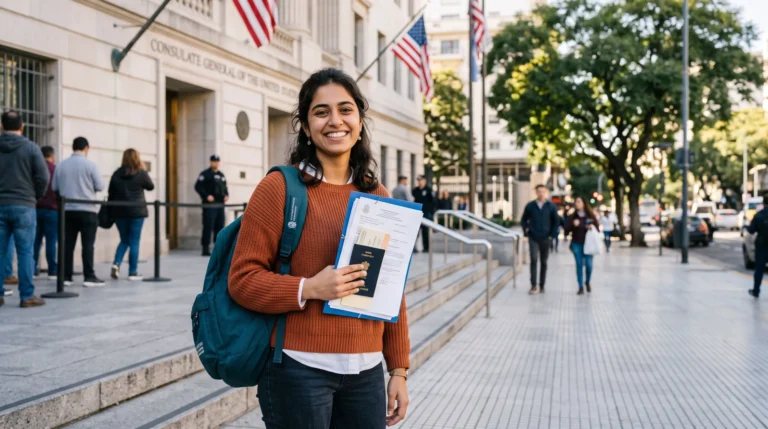
You walked out of that interview and it was over in under two minutes. No real conversation, just a slip of paper with a section number on it: 214(b). If you’re reading this right after that happened, here’s the first thing you need to hear: this is not the end of your plan to study abroad, and it isn’t a judgment on you as a person or a student. It’s a specific, well-defined legal presumption, and it’s one you can push back against with the right preparation.
What 214(b) actually means
Section 214(b) of the Immigration and Nationality Act starts from a legal presumption: every applicant for a nonimmigrant visa, F-1 included, is assumed to intend to immigrate permanently unless they prove otherwise. That burden of proof sits entirely on you. The consular officer isn’t required to prove you intend to stay. You’re required to convince them, in a few short minutes, that you don’t.
That’s the whole mechanism. It’s not about your grades, your school’s ranking, or whether you’re a good person. It’s about whether you presented enough evidence, in that specific interview, that your life pulls you back home when your program ends.
The most common reasons officers cite
Understanding why this happens is the entire key to fixing it. The most frequent factors behind an F-1 214(b) denial are:
- Weak or unclear ties to your home country — no stable family situation, no property, no job or career path waiting for you, nothing concrete pulling you back.
- Vague or inconsistent answers about your study plan — if you can’t clearly explain why this specific program, at this specific school, fits your career goals, it reads as uncertainty rather than intent.
- Shaky financial documentation — funding that looks incomplete, unexplained, or too thin to cover your actual costs raises questions about both your ability to study and your reasons for being in the US at all.
- Academic inconsistencies — large unexplained gaps, a mismatch between your prior field of study and your new program, or grades that don’t support your stated goals.
- Age and life-stage red flags in the officer’s eyes — this one is unwritten but real: older applicants, or those switching fields significantly, sometimes face more scrutiny about long-term intent.
- Any hint of a pending immigrant petition or close family members who’ve already immigrated — even when unrelated to your own plans, this can shift the presumption further against you.
None of these are permanent facts about you. They’re gaps in the evidence you presented on one specific day.
Can you reapply immediately?
Yes. There is no mandatory waiting period after a 214(b) denial. You can walk out of the consulate and, in principle, book another interview the same week. But speed without a better case is how people collect a second and third denial. Each new denial becomes part of your visa history, and consular officers can see it. The goal isn’t to reapply fast. It’s to reapply once you can answer the exact question that tripped you up the first time.
How to actually build a stronger reapplication
Identify precisely what went wrong. Think back, or write down immediately after the interview, exactly what was asked and where the officer’s tone shifted. Was it your funding explanation? Your answer about post-graduation plans? This is the single most useful diagnostic step and most applicants skip it.
Strengthen your ties to home, concretely. Vague statements like “I plan to return” carry no weight. A specific job offer waiting for you, a family business you’re connected to, property, or a clear enrolled sibling or dependent situation carries real weight. Bring documentation, not just a story.
Get your financial picture airtight. If your funding was the weak point, close every gap: clear bank statements, a clean explanation for any large or unusual deposits, and documentation for every funding source, whether that’s a sponsor, a scholarship, or savings. If your scholarship situation is part of the picture, our guide on bridging a scholarship offer into a visa application covers exactly how to present that cleanly.
Practice a specific, confident answer to “why this program.” Generic answers about wanting “a better education” read as a red flag. A clear line connecting your background, this specific program, and your career plan back home reads as intent, not uncertainty.
Know the questions before you walk in. A huge share of 214(b) denials come down to hesitation or inconsistency under a handful of predictable questions. We’ve broken down exactly what US consular officers actually ask F-1 applicants, and running through that list beforehand changes how you perform far more than most people expect.
Consider timing and consistency. If circumstances have genuinely changed since your denial — a new job offer at home, a stronger funding source, a clearer program fit — say so plainly and be ready to show it. If nothing has changed, an officer can often tell, and reapplying without new evidence tends to repeat the same outcome.
When to bring in an immigration attorney
Most 214(b) cases don’t need a lawyer. This is a documentation and preparation problem, not usually a legal one. But if you’ve been denied more than once, if your case involves a prior US visa violation, or if there’s a family immigration history complicating your intent case, a consultation with an immigration attorney before your next interview is worth the cost.
The bigger picture
A 214(b) denial feels personal in the moment. It isn’t. It’s a snapshot judgment made in a very short window, based on the specific evidence you had in front of you that day. Plenty of students denied once are approved on their second or third attempt, not because anything about who they are changed, but because they closed the specific gap that tripped them up. If you’re heading into any visa interview — F-1 or otherwise — our full B1/B2 interview question guide is also useful for understanding how consular officers think, and if you’re still finalizing where to study, this comparison of top countries for international students is worth a look before you lock in your next attempt.
FAQ
Can I reapply for an F-1 visa right after a 214(b) denial?
Yes, there’s no required waiting period. What matters is whether you have new or stronger evidence to present, not how quickly you reapply.
Does a 214(b) denial go on my permanent record?
It’s recorded in your visa history and visible to consular officers on future applications, but it isn’t a ban. Many applicants are approved on a later attempt once they address the specific weakness in their case.
Will a lawyer guarantee my next application is approved?
No one can guarantee a visa approval, including an attorney. What legal help can do is identify documentation gaps or complicating factors you might miss on your own, particularly in more complex cases.
Is 214(b) the same as a visa ban?
No. It’s a case-by-case determination that you didn’t sufficiently prove nonimmigrant intent at that interview. It doesn’t prevent you from applying again.
Related reading: F1 Student Visa Interview Questions 2026 · From Scholarship Offer to Student Visa · Best Countries for International Students in 2026
Sources: Immigration and Nationality Act, Section 214(b); US Department of State — Visa Denials. This is general informational content, not legal advice — an immigration attorney can assess complicating factors specific to your case.
Official sources to check before you apply or travel
Visa rules, fees, processing times and entry requirements change often. Always confirm the current requirements on the official government website, or with the embassy or consulate, before you apply, pay or travel. One Visa Center is an independent information site, not a law firm or government agency, and this article is not legal advice. Read how we research, fact-check and use AI tools in our Editorial Policy.
Get visa, passport, and travel-planning guides like this one sent straight to your inbox — plus first access to new country guides and scholarship roundups.